
Where Forest Meets Pacific: Inside Waldorf Astoria's Debut Costa Rican Sanctuary
Punta Cacique marries Guanacaste's volcanic terroir with the brand's signature grace - and signals a new chapter for luxury in Central America's most biodiverse corner.
SI
7 Jul 2026 · 5 MIN READ · UPDATED 17 AUG 2026
The Arrival
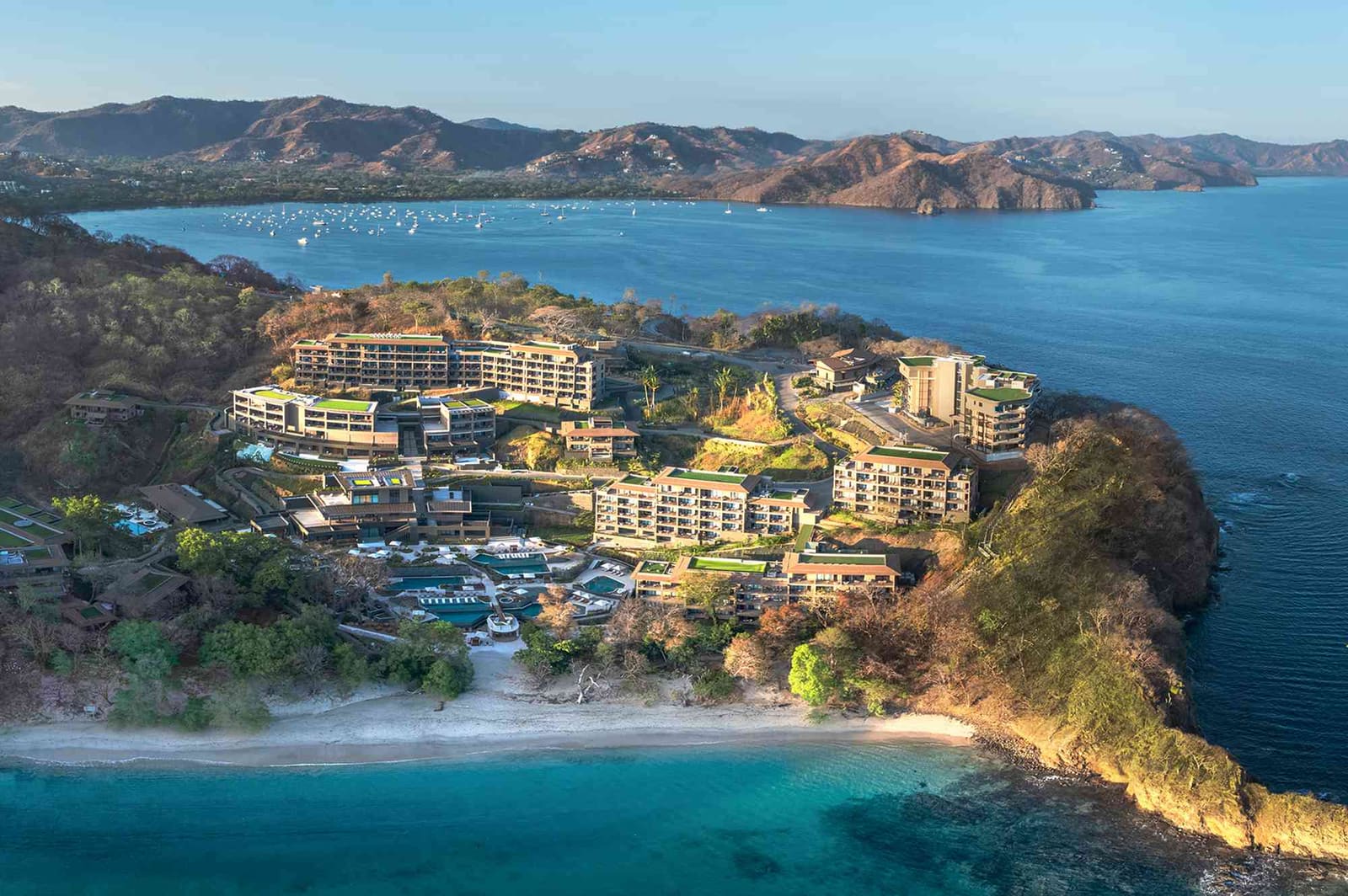
You smell it before you see it: salt air mingling with frangipani, the faint char of wood smoke drifting from an open kitchen somewhere beyond the palms. The drive from Liberia winds through cattle ranches and dry forest, the landscape shifting from dust to green as you climb toward the ridge. Then the gates part, and Waldorf Astoria Costa Rica Punta Cacique reveals itself not as an interruption of the jungle but as an extension of it - low-slung pavilions in honey-toned stone, thatched roofs pitched like the wings of frigatebirds, and everywhere, the sound of water moving over rock.
At Global Chic Voyage, we've watched Central America's luxury landscape evolve from colonial retrofits and beachfront compounds into something more considered, more rooted. This property, the brand's inaugural venture in Costa Rica, feels less like a transplant and more like a homecoming - a marriage of the group's polished hospitality DNA with the volcanic terroir, the tidal rhythms, and the quiet intensity of Guanacaste.
Rooms That Frame the Horizon
The suites here are exercises in restraint. Floor-to-ceiling glass opens onto private terraces; interiors favour local hardwoods, woven textiles in indigo and ochre, and bathrooms carved from travertine that echoes the limestone outcrops dotting the coast. There are no superfluous gestures - no gilded mirrors or overwrought chandeliers. Instead, the design language speaks in negative space: the gap between bed and window, the shadow cast by a ceramic vessel on a side table, the way morning light pools on polished concrete.
What strikes us most is the orientation. Every suite, whether perched on the hillside or tucked into the canopy, is angled toward the Pacific. You wake to the sight of waves folding onto black sand, the horizon line unbroken save for the occasional fishing skiff or passing pod of humpbacks. It is a view that demands nothing and offers everything - a daily reset, a reminder of scale.
Coffee as Terroir
The property sits within a working coffee estate, and the kitchen treats the bean not as a breakfast amenity but as a lens through which to understand the region. Guests are invited to walk the rows at dawn, when the air is cool and the cherries are at their most aromatic, and to observe the processing mill where fruit is depulped, fermented, and dried on raised beds under the Guanacaste sun.
This is not agritourism as theatre. The estate has been producing coffee for decades, long before the hotel took shape, and the ritual of harvest, roast, and cup is woven into the property's daily rhythm. At breakfast, a barista walks you through single-origin pour-overs, each batch tagged with elevation, varietal, and harvest date. The coffee is bright and clean, with notes of stone fruit and a finish that lingers like the memory of a good conversation.
It is, we think, an elegant inversion of the luxury-resort script: rather than importing prestige from elsewhere, Punta Cacique anchors itself in what already grows here, in what has always grown here, and invites guests to pay attention.
A Kitchen Rooted in Place
The dining programme is led by a team that sources from nearby farms, coastal fisheries, and the property's own gardens. Menus shift with the season and the catch, but certain through-lines emerge: grilled octopus with tamarind and chilli, ceviche spiked with green mango and culantro, wood-fired whole snapper dressed in nothing more than lime and sea salt.
There is a confidence in the cooking, a willingness to let ingredients speak without mediation. The kitchen does not chase trends or import techniques for their own sake; instead, it draws on the culinary grammar of the Pacific coast - slow marinades, high heat, the interplay of smoke and acid - and executes with precision. Breakfast brings casado plates reimagined for the morning table, platters of tropical fruit cut to order, and those estate coffees we mentioned, each cup a small geography lesson.
We have eaten our way through enough resort restaurants to recognise when a kitchen is performing luxury and when it is practising hospitality. Here, it feels like the latter.
The Broader Canvas
Waldorf Astoria's decision to plant its first Costa Rican flag in Guanacaste rather than the Central Valley or the Caribbean coast is telling. The region has long been a draw for surfers, sportfishers, and a certain breed of traveller content to sleep in hammocks and eat rice and beans for a week. But in recent years, the province has begun to attract a different kind of investment - properties that take seriously the question of how luxury can coexist with ecological fragility, how a resort can employ hundreds without erasing the culture that drew guests in the first place.
Punta Cacique arrives at a moment when Costa Rica's reputation as a conservation leader is being tested by its own popularity. The country welcomed record visitor numbers in recent years, and the infrastructure - roads, water systems, waste management - has struggled to keep pace. For a brand with Waldorf Astoria's legacy, the challenge is not simply to build beautifully but to build responsibly, to demonstrate that high-end hospitality and environmental stewardship are not opposing forces but complementary ambitions.
The property has taken steps in that direction: solar arrays supplement grid power, greywater is treated and reused for landscaping, and single-use plastics have been largely eliminated from operations. These are table stakes now, baseline expectations rather than selling points. What matters more is whether the hotel becomes a meaningful economic engine for the surrounding communities, whether it trains and promotes locally, whether it resists the temptation to become a gated enclave insulated from the very place it purports to celebrate.
The Ritual of Slowness
There is a spa, naturally, and it is as you would expect: treatment rooms open to the breeze, therapists trained in both Western modalities and local healing traditions, a menu that leans heavily on volcanic clay, cacao, and coffee-bean scrubs. But what we found ourselves returning to was not the spa but the pool - a long, narrow lap lane that seems to spill directly into the ocean below, its infinity edge calibrated to create the illusion of continuity, of water meeting water without interruption.
We spent an afternoon there, alternating between laps and long stretches of doing nothing, watching howler monkeys traverse the canopy overhead and pelicans skim the surf. It was the kind of idleness that feels radical in an age of curated itineraries and algorithmic recommendations, the kind of luxury that has little to do with thread count or turndown service and everything to do with permission - to be still, to be silent, to let the day unfold without agenda.
What It Signals
Punta Cacique is not the first luxury resort to open in Costa Rica this decade, nor will it be the last. But its arrival feels significant nonetheless, a signal that the country's hospitality landscape is maturing beyond eco-lodges and surf camps into something more layered, more nuanced. The property does not erase the rustic charm that has long defined Costa Rican tourism; instead, it offers an alternative grammar, a way of experiencing the country that privileges comfort and craft without sacrificing authenticity.
For travellers who have exhausted the Caribbean's private-island circuit or grown weary of the Riviera Maya's mega-resorts, Punta Cacique presents a compelling case: that luxury in Latin America need not be derivative, that it can be both polished and particular, that it can honour tradition while writing new chapters.
We left with our bags heavier - coffee beans, a ceramic mug from the gift shop, a linen shirt dyed with natural indigo - and our minds quieter. The forest had met the Pacific, and for a few days, we had been allowed to stand at the threshold.
Credit: Waldorf Astoria Punta Cacique
Spot something wrong? Email editors@globalchicvoyage.com. We log every correction publicly.
RELATED
SEE ALL →
25 Jun 2026 / 5 min
27 Jul 2026 / 5 min
8 Jul 2026 / 5 min

31 Jul 2026 / 5 min