
When a Homesick Princess Brought the Palazzo Home
A 17th-century Oxfordshire estate, born of an Italian love story and shaped by centuries of artistic patronage, arrives on the market
CG
9 Jul 2026 · 5 MIN READ · UPDATED 17 AUG 2026
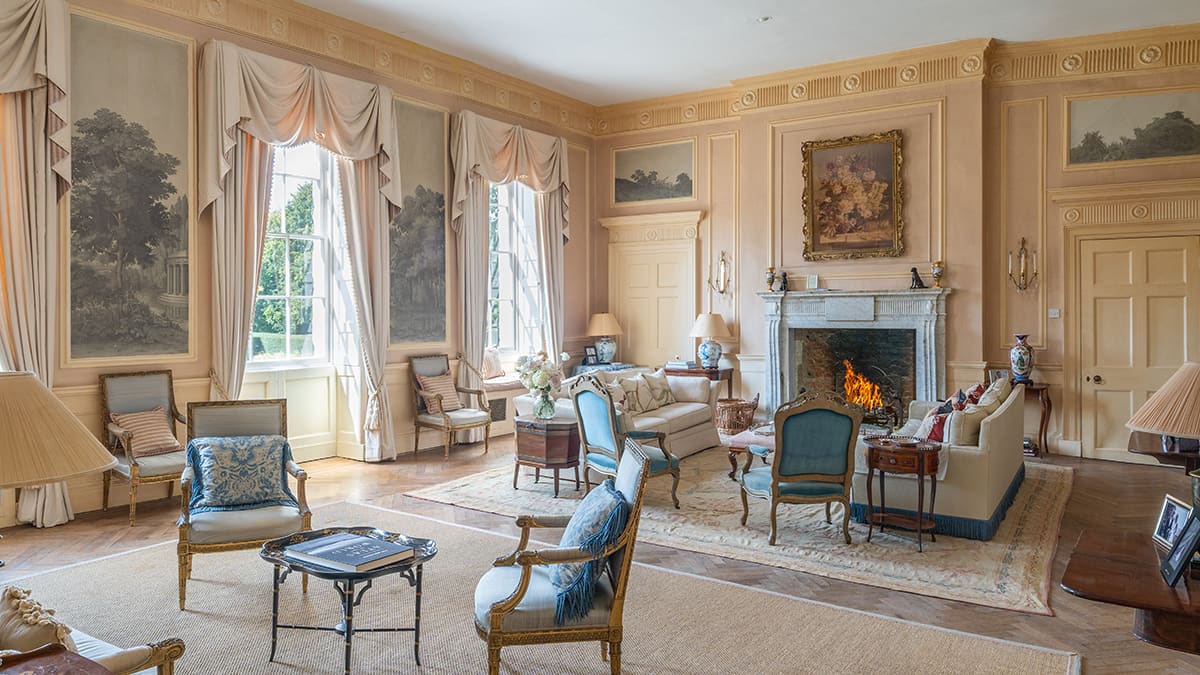
A Palazzo in the Cotswolds
There are houses built for function, and then there are houses built for longing. Newington House belongs to the latter. In the late 1600s, somewhere between the Thames Valley meadows and Oxford's dreaming spires, Henry Dunch commissioned a residence for his wife that would ease her homesickness. Maria Pallavicini had grown up in the grandeur of Genoa, and so her new English home would echo the Palazzo Pallavicini, its limestone facade a love letter rendered in architecture.
The result is a Grade II-listed country house that feels as much Italian as English, a curious hybrid that has watched the Oxfordshire countryside change for more than three centuries. Now, the estate spanning forty-three acres along the River Thame is seeking new stewardship, offered through Savills Private Office at £14.25 million, roughly $19 million. For those who prefer a more tailored approach, the property can be acquired in three separate parcels: the main residence at £9.95 million, a Grade II-listed Manor House at £2.45 million, and a Coach House at £1.95 million, each with independent access and gardens.
At Global Chic Voyage, we have long believed that the most compelling estates are those shaped by emotion rather than mere ambition. Newington House is precisely that: a monument to memory, to the ache of distance, and to the lengths one will go to make a beloved feel at home.
Layers of Time, Rooms of Stories
The house Henry Dunch built was grand, but not yet complete. By the late 18th century, another generation added a full floor and the Corinthian-columned entrance porch that now frames the arrival. With this expansion came marble fireplaces and decorative plasterwork that still anchor the formal reception rooms, their details a study in Georgian refinement layered atop Italianate bones.
Walk through Newington House today and you move through strata of taste and era. Original timber beams cross ceilings. Paneled walls give way to parquet floors that creak gently underfoot. French wallpaper murals unfold in dining rooms where towering sash windows frame the gardens beyond. The residence stretches across more than 13,000 square feet, accommodating seven bedrooms and a lower level outfitted with a gym, games room, and spaces for gatherings that spill late into the evening.
But square footage tells only part of the story. Newington's true measure lies in the lives it has held.
The Bloomsbury Years
In the early 1900s, the estate passed into the hands of Ethel Sands, an American-born painter whose social orbit glittered with the era's literary and artistic elite. Henry James arrived. So did Arnold Bennett, Walter Sickert, and members of the Bloomsbury Group, including Virginia Woolf. It is easy to imagine them in the formal dining room, debating aesthetics over long dinners, or wandering the grounds in search of inspiration.
Sickert, a painter drawn to interiors and intimate moments, completed several works here. Among them: Ethel Sands Descending the Staircase at Newington, a canvas that captures both the house and its hostess in a single, luminous instant. The painting endures in collections today, a fragment of Newington's cultural legacy preserved in oil and light.
For a property to have served as backdrop to such a circle is no small thing. The Bloomsbury Group reshaped British modernism, their conversations and collaborations rippling through literature, art, and design for decades. That Newington House hosted those exchanges lends it a resonance beyond architecture.
A Family's Three Decades
The Nettleton family acquired Newington House in 1991 for £1.58 million, according to property records. Over the thirty-plus years since, they undertook a careful restoration, one that honored the home's historical fabric while adapting it to contemporary family life. They added a lake, a swimming pool, a tennis court, and expanded the woodland. They raised children within these walls, filling rooms that had once hosted Bloomsbury bohemians with a different kind of vitality.
James Nettleton, reflecting on his family's tenure, noted that the house never felt like a museum. It was, he said, loved rather than preserved, lived in rather than displayed. That distinction matters. Historic properties can become mausoleums if their caretakers prioritize preservation over presence. The Nettletons chose otherwise, allowing the estate to breathe, to evolve, to remain a home rather than a relic.
Their work is evident throughout. The grounds now incorporate formal gardens, a greenhouse, an open-air cabana beside the pool, a croquet lawn. Beyond the manicured zones lie stabling blocks, paddocks, a boating lake, and stretches of unspoiled woodland where the boundary between estate and countryside softens.
The Geometry of Romance
Crispin Holborow of Savills Private Office describes Newington House as a limestone masterpiece admired for its elegant scale and symmetry. He calls it a once-in-a-lifetime opportunity to acquire one of Oxfordshire's most distinguished country houses. The language is the language of real estate, but the sentiment is sound. Properties of this provenance rarely come to market, and when they do, they attract a particular kind of buyer: one for whom history and beauty are not amenities but essentials.
The estate's symmetry is indeed striking. The Italianate facade, with its careful proportions and classical detailing, reads as both stately and intimate, grand without being forbidding. It is architecture that invites rather than intimidates, a quality that has likely contributed to its enduring appeal across centuries and ownerships.
What makes Newington House compelling is not merely its age or its famous guests, but the story it tells about desire and adaptation. Maria Pallavicini did not simply endure her displacement; her husband built her a reminder of where she came from. That gesture, romantic and extravagant, shaped a house that has since absorbed the lives and aesthetics of everyone who followed. The result is a layered, textured place, one where Genoese palazzo meets Georgian expansion meets Edwardian bohemia meets 21st-century family life.
The Market for Memory
The luxury real estate market has, in recent years, shown a pronounced appetite for properties with narrative depth. Buyers at this tier are not merely acquiring square footage or acreage; they are acquiring legacy, story, a sense of continuity with the past. Newington House offers all three in abundance.
Oxfordshire itself remains a perennially desirable location, positioned between London's gravitational pull and the Cotswolds' pastoral allure. The proximity to Oxford adds intellectual and cultural capital, while the surrounding countryside provides the privacy and beauty that define the English country house ideal. The River Thame, winding through the estate's acreage, offers both scenic value and a tangible connection to the landscape's history.
For international buyers, particularly those with ties to Europe or an appreciation for cross-cultural architecture, Newington House presents a rare synthesis. It is unmistakably English in setting and evolution, yet its origins are Mediterranean, its aesthetic vocabulary borrowed from another latitude entirely. That duality gives it a cosmopolitan dimension unusual in the genre.
A House That Breathes
At Global Chic Voyage, we have walked through countless estates that feel frozen, their interiors preserved with such rigor that they resist inhabitation. Newington House, by all accounts, is not one of them. The Nettletons' approach, prioritizing livability over museum-grade stasis, suggests a property that can still adapt, still welcome new rhythms and routines.
The inclusion of modern amenities like the gym, games room, and swimming pool cabana does not diminish the historical character; rather, it demonstrates that the estate can accommodate contemporary life without sacrificing its soul. The separate lots for the Manor House and Coach House offer flexibility, whether for multigenerational living, guest accommodations, or staff quarters. That modularity is increasingly valuable in a market where buyers seek both grandeur and practicality.
The grounds, too, reflect a balance between formality and wildness. The croquet lawn and formal gardens provide structure, while the woodland and lake offer spaces for exploration and solitude. It is a landscape designed for both entertaining and retreat, a duality that mirrors the house itself.
The Weight of Stewardship
To purchase a property like Newington House is to accept a form of stewardship. The next owner will inherit not only the physical structure but also the responsibility of continuing its story. How will they balance preservation with adaptation? Will they open the estate for cultural events, as Ethel Sands once did, or keep it as a private sanctuary? Will they restore elements that have faded, or allow the patina of age to deepen?
These are not merely practical questions; they are philosophical ones, rooted in how we relate to history and place. The best custodians of historic properties understand that their role is neither to freeze time nor to erase it, but to add a thoughtful chapter to an ongoing narrative.
Newington House has been many things: a gesture of love, a gathering place for artists, a family home. What it becomes next will depend on who walks through that Corinthian-columned porch and decides to stay. We hope they bring reverence, imagination, and a willingness to let the house continue breathing, as it has for more than three centuries.
Photo: Will Eastwick-Field / Savills
Spot something wrong? Email editors@globalchicvoyage.com. We log every correction publicly.
RELATED
SEE ALL →9 Jul 2026 / 5 min

8 Aug 2026 / 5 min

7 Aug 2026 / 5 min

31 Jul 2026 / 5 min