
When Less Becomes More on the Water: A Turkish Yard Rethinks Yacht Design
Alia Yachts' latest 148-foot commission inverts the industry's maximalist impulse, proving that subtraction can be the most radical gesture of all.
SI
17 Jun 2026 · 5 MIN READ · UPDATED 17 AUG 2026
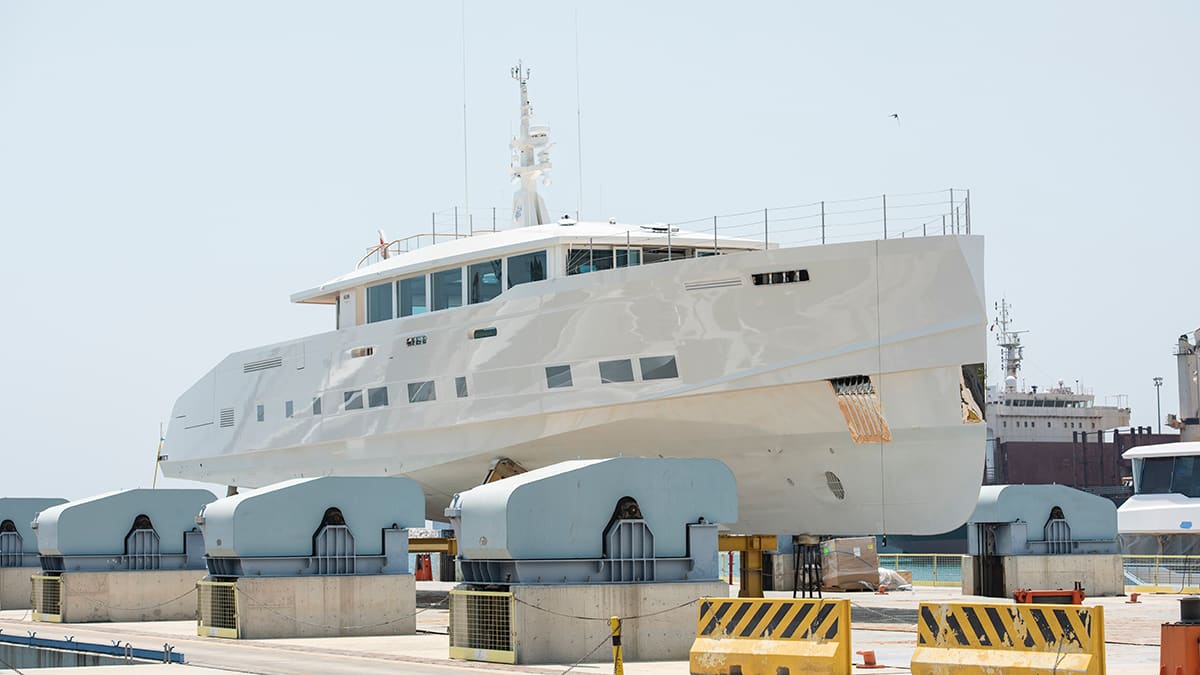
An Act of Restraint in a Sea of Excess
There is a paradox at the heart of contemporary superyacht design: the larger the vessel, the more it seems to insulate its occupants from the very element it traverses. Walk through a modern 200-footer and you might forget you are at sea altogether, cocooned in marble-clad salons and climate-controlled corridors that could belong to a Park Avenue penthouse. So when a Turkish shipyard announces it has delivered a 148-foot custom build predicated not on maximizing internal volume but on editing it down, the news feels less like a product launch and more like a manifesto.
At Global Chic Voyage, we have watched the yacht industry oscillate between two poles: the floating palace and the performance machine. Alia Yachts' Genie Blu suggests a third path, one that borrows the low-slung silhouette of a sports car yet privileges serenity over speed, proportion over power. It is a yacht designed, according to Alia president Gökhan Çelik, to turn traditional ideas on their head, favoring purity and the owner's lived experience of the ocean above all else.
The vessel emerged from a brief that can only be described as intentionally contrarian. Where most contemporary commissions begin with a checklist of amenities and a mandate to stuff every cubic meter with saleable space, this owner arrived with a different set of priorities: architectural clarity, unobstructed sightlines, and a design language rooted in subtraction rather than accumulation. The result is a yacht that reads, from every angle, as a study in restraint.
Collaboration Across Borders
Alia's in-house design team partnered with Italy's Luca Dini Design & Architecture to realize the project, a collaboration that married Turkish shipbuilding precision with Italian spatial sensibility. The exterior is characterized by clean, almost Brutalist lines and a long, low superstructure that refuses to rear up in the way so many modern yachts do. There is no towering flybridge, no stacked wedding cake of decks. Instead, the profile is horizontal, elongated, almost geological in its stratification.
Luca Dini describes the design philosophy as one of removal. Barriers were eliminated, unnecessary volume reduced, and openings carved wherever structurally feasible. It is an approach more commonly associated with minimalist residential architecture than with marine design, where regulatory constraints and engineering realities often conspire against simplicity. Yet here, the yacht manages to feel both spacious and intimate, a trick achieved not through sheer square footage but through the careful orchestration of light, materiality, and view.
Living Spaces That Breathe
Step inside the main salon and the first thing you notice is not what is there, but what is absent. No heavy drapes, no ornamental flourishes, no competing focal points. The layout is open-plan, with floor-to-ceiling glass panels that dissolve the boundary between interior and exterior. Drop-down side wings extend the living area outward when conditions allow, transforming the salon into a pavilion suspended above the waterline.
The decor, as described by the yard, is calm and contemporary: a neutral palette of sand, stone, and pale timber, punctuated by simple, sculptural furnishings. It is the kind of interior that does not compete with its surroundings but rather frames them, allowing the shifting light and seascape to become the primary aesthetic event. We have seen this strategy employed to great effect in resort design, particularly in the Aegean and the Cyclades, where architects like K-Studio and Block722 have long understood that the best interiors are those that know when to step aside.
The sense of flow extends to the exterior decks. Aft, a raised cockpit features seating that cascades down a series of steps toward a swim platform, offering a graduated transition from vessel to sea. Forward, a generous lounge area and an open foredeck provide multiple zones for entertaining or solitary contemplation. Up top, a private sun pad is recessed into the superstructure, sheltered yet open to the sky.
The Philosophy of Subtraction
What makes Genie Blu noteworthy is not any single feature, but the cumulative effect of a design ethos that privileges experience over inventory. In an industry where success is often measured in gross tonnage and the number of guest cabins, this yacht represents a quiet rebellion. It is a vessel built for someone who already knows what they want and, perhaps more importantly, what they do not.
This kind of confidence is rare. Most yacht owners, understandably, want to hedge their bets, to ensure that every conceivable need is met by built-in infrastructure. The result is often a sort of nautical maximalism: gyms, spas, beach clubs, helipads, tender garages large enough to house a small fleet. Genie Blu takes the opposite tack, trusting that a well-proportioned space, thoughtfully detailed and opened to the elements, will deliver more lasting satisfaction than any amenity checklist.
We see echoes of this philosophy in the work of certain contemporary architects who have turned away from the sculptural bombast that defined the early 2000s in favor of quieter, more rigorous interventions. Think of the pared-down villas of Studio MK27 in Brazil, or the elemental beach houses of John Pawson. These are projects that understand luxury not as accumulation but as editing, as the freedom to live with less and feel more.
A Vessel for the Visionary
While the yard has not officially confirmed the owner's identity, social media posts earlier this week suggest the yacht was delivered to an Italian entrepreneur with a well-documented appetite for design and performance. In a video shared online, the new owner described the delivery as a special day for his family, offering a blessing for the vessel and all who sail aboard her.
That sense of personal investment is palpable in the finished product. Genie Blu does not feel like a spec yacht, built to appeal to the widest possible market. It feels bespoke in the truest sense: a physical manifestation of one individual's vision, shaped by a design team willing to follow that vision to its logical conclusion, even when it meant defying industry norms.
This is, we would argue, the future of high-end yacht design. As the market matures and clients become more sophisticated, the demand will shift from vessels that do everything to vessels that do a few things exceptionally well. The challenge for shipyards will be to resist the gravitational pull of convention, to trust that there is a market for yachts that prioritize experience over specification, atmosphere over amenity.
A New Benchmark for Mediterranean Cruising
Genie Blu is particularly well-suited to the kind of slow, contemplative cruising that defines the best of Mediterranean yachting. Its low profile and horizontal emphasis recall the traditional motor yachts of the 1960s and 70s, vessels like the classic Benettis and Feadships that were designed to glide through the Côte d'Azur or the Amalfi Coast with understated elegance. Yet the design language is unmistakably contemporary, informed by a minimalist aesthetic that feels more aligned with Scandinavian or Japanese sensibilities than with the ornate classicism that has long dominated European yacht design.
We imagine this yacht anchored off Formentera at dusk, its glass walls glowing softly, the interior and exterior merging into a single, continuous space. Or rounding the headlands of the Turkish Riviera, its clean lines silhouetted against the rocky coast. These are the settings in which Genie Blu will reveal its full character, where the interplay of architecture and landscape becomes the defining luxury.
Implications for the Industry
The broader significance of Genie Blu lies in what it signals about the evolving priorities of the ultra-high-net-worth demographic. For years, the yacht industry has operated on the assumption that bigger is better, that gross tonnage is the ultimate metric of success. But as wealth becomes less about display and more about access to rarefied experiences, the calculus is shifting. Clients are asking not for more space, but for better space. Not for more features, but for more thoughtful design.
This shift has implications that extend beyond yacht design. We are seeing parallel movements in hospitality, where the most sought-after properties are often the smallest and most carefully curated. Think of the micro-resorts proliferating across the Greek islands, or the single-villa retreats in Bali and Sri Lanka that command premium rates precisely because they offer intimacy and intentionality rather than scale.
Alia Yachts, with Genie Blu, has demonstrated that the same principles can be applied to the marine sector. The question now is whether other yards will follow suit, or whether this remains an outlier, a one-off commission for a client with unusually clear taste. Our suspicion is that this is the beginning of a broader trend, one that will see the industry move away from the arms race of amenities and toward a more nuanced understanding of what constitutes luxury on the water.
The Art of Doing Less
In the end, Genie Blu is a reminder that the most radical gesture in contemporary design may be the simplest: to do less, and to do it better. To trust that a well-proportioned space, flooded with natural light and opened to the sea, can deliver more pleasure than a floating resort packed with every conceivable amenity. To understand that luxury, at its highest expression, is not about abundance but about choice, about the freedom to edit one's environment down to its essential elements.
We will be watching to see how the market responds, and whether other owners are willing to embrace this philosophy of subtraction. If Genie Blu is any indication, the future of yacht design may be quieter, cleaner, and more connected to the elemental experience of being at sea. And that, we would argue, is a future worth sailing toward.
Spot something wrong? Email editors@globalchicvoyage.com. We log every correction publicly.
RELATED
SEE ALL →
22 Jul 2026 / 5 min
23 Jul 2026 / 5 min
16 Jul 2026 / 5 min
31 Jul 2026 / 5 min