
When Shipyards Turn to Shadow: The New Language of Luxury at Sea
ISA Yachts delivers its largest vessel yet, wrapped in black steel and a philosophy that redefines presence on the water.
VJ
22 Jul 2026 · 5 MIN READ · UPDATED 17 AUG 2026
A Quarter-Century in the Making
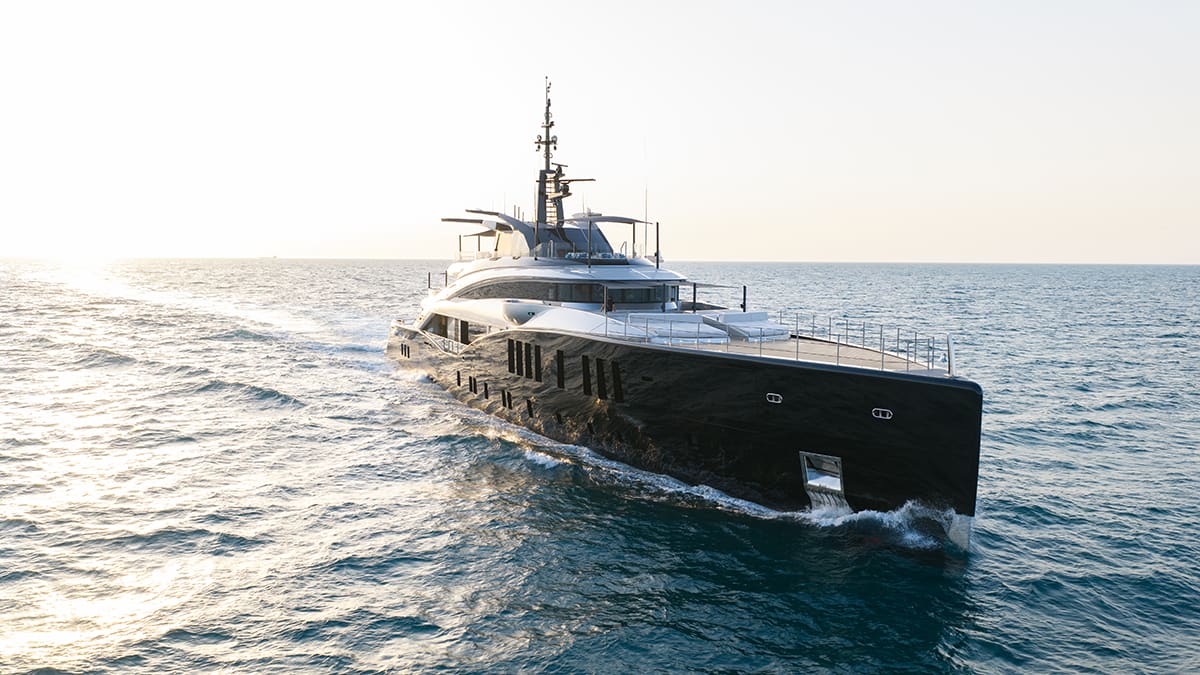
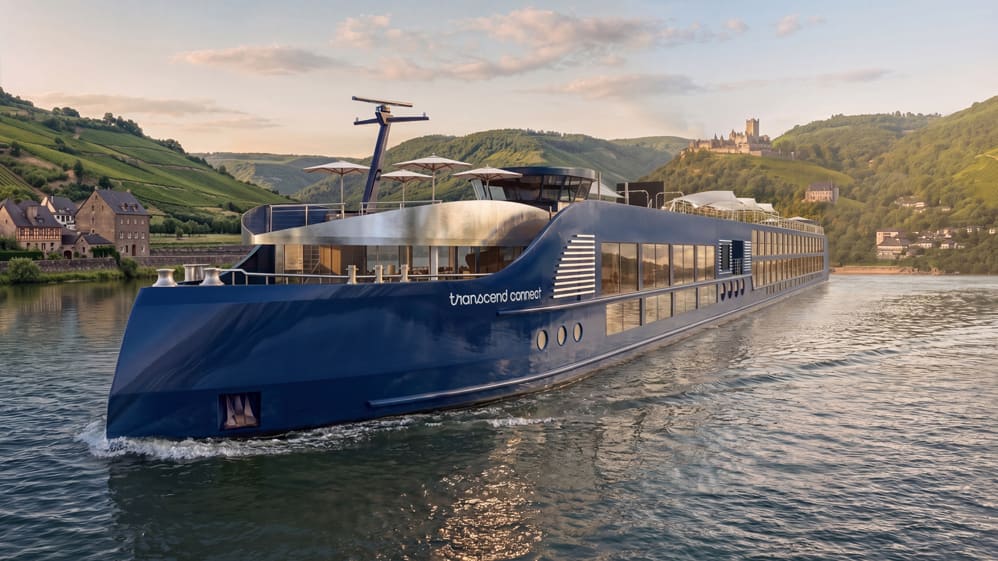
There is a moment, late in the afternoon at certain Mediterranean anchorages, when the light slants low across the water and every yacht becomes a silhouette. Most vessels disappear into sameness then, their white hulls reduced to pale ghosts. But imagine, instead, a form that holds its shape against the dusk - a hull so dark it seems to gather shadow rather than reflect it, topped by a superstructure that catches the last silver of daylight like a blade.
At Global Chic Voyage, we've watched the language of luxury yachting evolve from the predictable palette of Arctic white and teak to something more considered, more architectural. The arrival of ISA Yachts' largest vessel in its 25-year history marks not simply a milestone in scale but a shift in how presence is articulated on the water. Stretching 220 feet, this newest addition to the Gran Turismo line - a family of performance-oriented vessels that the Palumbo Superyachts-owned shipyard reimagined three years ago - arrives with a black steel hull that refuses the visual conventions of its peers.
The Geometry of Contrast
Vallicelli Design, entrusted with the exterior architecture, has rendered something closer to sculpture than transport. The black hull sits low and purposeful, its mass grounded by color that absorbs rather than announces. Above, an aluminum superstructure finished in silver creates not merely contrast but conversation - a dialogue between weight and lightness, between the solid and the ephemeral.
The silhouette itself is a study in tension. Long, flowing lines that suggest speed even at anchor are interrupted - deliberately, provocatively - by the sharp geometry of the transom and the angular architecture of the sundeck roof. A frame element, running from the wheelhouse aft to the bulwark on the main deck, functions less as ornament and more as a visual through-line, lending coherence to what might otherwise read as competing languages. It is, in effect, an automotive gesture translated to naval architecture, a nod to the Gran Turismo lineage that now spans six models from roughly 108 to 262 feet.
The in-house naval architecture supports this aesthetic ambition with engineering that prioritizes both performance and proportion. Twin MTU diesel engines generate a combined output exceeding 6,000 horsepower, propelling the vessel to a maximum speed just shy of 19 knots and a comfortable cruising pace of 16 knots. These are not figures that rewrite the record books, but they are honest - sufficient for the vessel's intended purpose, which is less about racing horizons and more about arriving with intention.
Interiors as Refuge
Enrico Gobbi of Team for Design has conceived the interior spaces with a restraint that complements the boldness outside. Accommodation extends to 14 guests across seven cabins, with an additional 13 crew housed in eight cabins - a ratio that speaks to the level of service expected aboard. The owner's suite claims the forward section of the main deck, spanning the full 30-foot beam in a layout that has become the signature of serious yachting: unobstructed views, direct access to private deck space, and the psychological comfort of occupying the vessel's most protected and prestigious real estate.
We have always believed that the best yacht interiors function as counterpoint to the drama of their settings. Where the exterior announces, the interior should whisper. Gobbi's work here - though details remain closely held ahead of the vessel's public debut - appears to honor that principle, offering refuge rather than spectacle, a backdrop to the more compelling theater unfolding beyond the glass.
Reimagining the Aft Experience
It is on the exterior decks, however, that the vessel reveals its most compelling argument. The entire aft section of the main deck has been reconceived around a panoramic swimming pool stretching approximately 21 feet - a feature that transforms what is typically a circulation zone into a destination. Two fold-down terraces extend laterally from the hull, multiplying waterside real estate and blurring the boundary between vessel and sea.
Integrated stairs descend directly to the swim platform and, beyond it, to a beach club equipped with hammam, bar, and gym. This is the vocabulary of the contemporary superyacht: wellness and water access, the rituals of relaxation elevated to design imperatives. But the most ingenious gesture lies below, in the garage on the lower deck. Sized to accommodate a tender exceeding 25 feet, the space doubles as a full-beam entertainment area once the tender is launched. The covered aft section, freed of its utilitarian cargo, transforms into an extension of the beach club, effectively doubling its footprint.
This flexibility - this insistence that space serve multiple, sequential purposes - reflects a broader evolution in yacht design. The vessels we return to are not those with the most square footage but those that understand how space contracts and expands with use, how a garage can become a salon, how a pool deck can function as both social hub and private retreat depending on the hour and the guest list.
The Monaco Debut
The vessel is scheduled to make its public debut at the Monaco Yacht Show, an event that unfolds each September at Port Hercule and functions as both marketplace and stage for the industry's latest thinking. It is there, among the familiar parade of white hulls and golden teak, that this black-hulled newcomer will test its thesis: that luxury at sea need not always gleam, that presence can be asserted through shadow as compellingly as through light.
We suspect the response will be polarized, as it often is when convention is challenged. There will be those who find the dark hull too severe, too reminiscent of military or commercial vessels, a departure from the aspirational brightness that yachting has long trafficked in. And there will be others - designers, collectors, the perpetually restless - who see in it a maturation of taste, a willingness to prioritize character over conformity.
A Shift in the Visual Vocabulary
What ISA Yachts has delivered, finally, is not simply a larger vessel but a different kind of presence. In an industry where differentiation is increasingly difficult - where every shipyard offers bespoke customization, where every yacht claims to redefine luxury - the choice of a black hull is both simple and radical. It is a chromatic departure that carries symbolic weight, suggesting a client base less interested in being seen and more interested in how they are seen.
At Global Chic Voyage, we have long argued that the future of luxury lies not in excess but in precision, not in volume but in voice. This vessel, with its studied contrasts and its refusal of the expected, offers a case study in that principle. Whether it heralds a broader trend toward darker palettes and more architectural silhouettes, or remains a singular expression of one owner's vision, remains to be seen. But it arrives at a moment when the visual vocabulary of yachting is ready for expansion, when shadow is finally being recognized as a color worth considering.
Photo: ISA Yachts
Spot something wrong? Email editors@globalchicvoyage.com. We log every correction publicly.
RELATED
SEE ALL →
23 Jul 2026 / 5 min
17 Jun 2026 / 5 min
16 Jul 2026 / 5 min
31 Jul 2026 / 5 min