
When the Caribbean Reveals Its Quieter Side: A Return to Turks and Caicos
Beyond the resorts and white sand clichés lies an archipelago that rewards the traveller who lingers - where the light shifts hourly and the cuisine speaks in Creole inflections.
SI
18 Jun 2026 · 5 MIN READ · UPDATED 17 AUG 2026
An Archipelago That Resists the Obvious
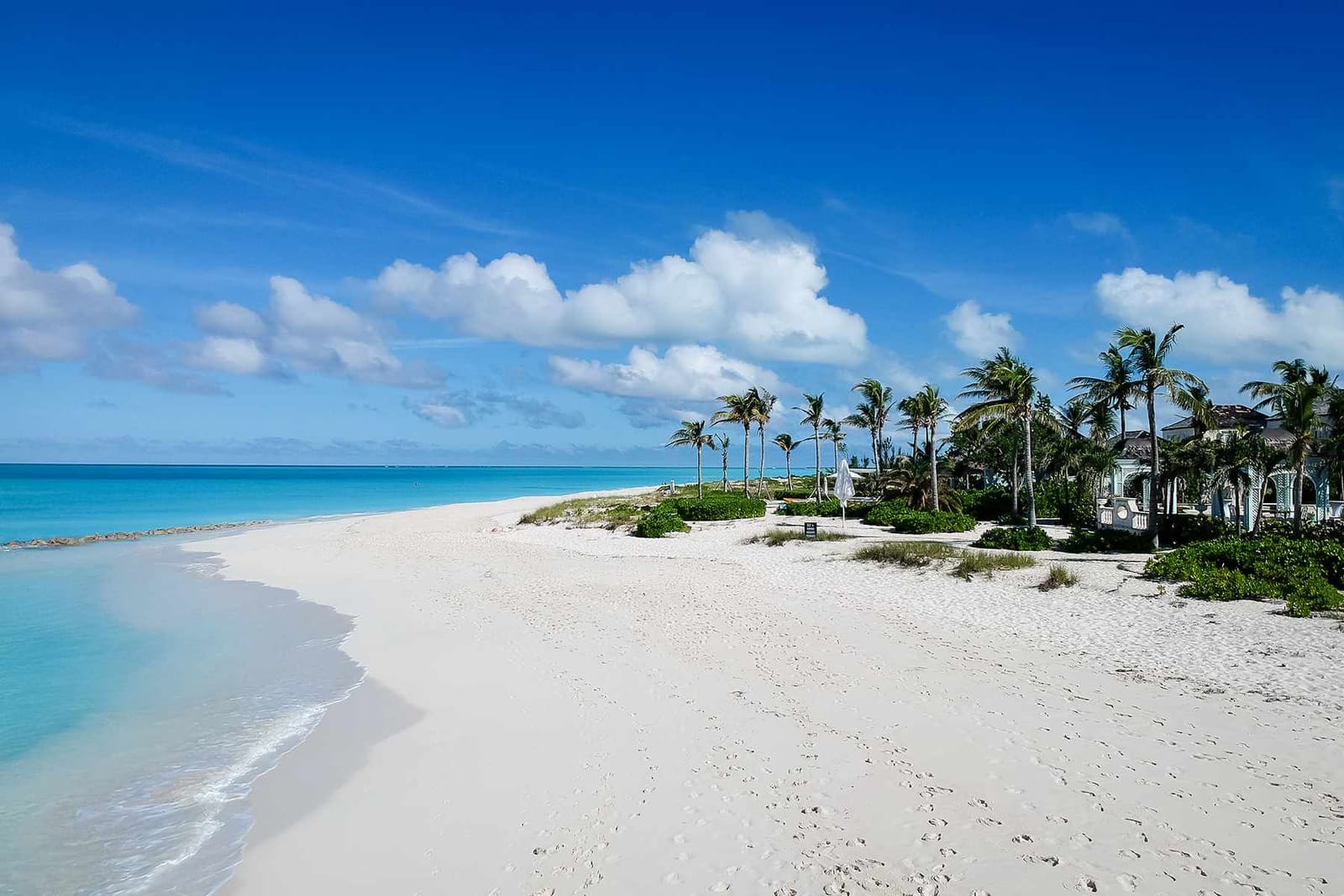
There is a moment, usually around four in the afternoon, when the light over Grace Bay softens from its midday glare into something gentler - a pale gold that pools in the shallows and makes the water look less like a postcard and more like a living thing. At Global Chic Voyage, we've watched Turks and Caicos evolve from a well-kept secret into a polished destination over the past decade, yet its quieter rhythms endure for those who know where to look. The archipelago sprawls across forty islands and cays, though only eight are inhabited, and therein lies its particular appeal: vast stretches of coastline where you might walk for an hour and encounter nothing but the occasional conch shell and the scalloped trails of ghost crabs.
The British Overseas Territory sits southeast of the Bahamas, a constellation of limestone and coral that has long attracted a certain kind of traveller - the one who values discretion over spectacle, who prefers a beach bar where the bartender remembers your name to a swim-up pool where anonymity is the point. It is not a destination that announces itself loudly. The architecture is low-slung and unobtrusive, the palette borrowed from the sea and sand, and the culture - a blend of Bahamian, Haitian, and British influences - expresses itself in subtle ways: in the cadence of conversation, in the way conch is prepared, in the hymns that drift from wooden churches on Sunday mornings.
Where to Rest Your Head
The accommodation landscape here has matured without losing its sense of place. On Providenciales, the island that anchors most itineraries, a handful of properties have managed to balance luxury with restraint. The Shore Club, which opened its doors several years ago, occupies a stretch of Long Bay Beach and favours clean lines and natural materials - teak, stone, local coral aggregate - over the baroque flourishes that can plague resort design. Its suites open directly onto the sand, and the absence of televisions in the bedrooms is a deliberate choice, a gentle nudge toward the horizon.
Further along the same coast, Wymara Resort inhabits a similar aesthetic territory: modernist pavilions, infinity pools that blur into the sea, a spa that uses indigenous botanicals. What sets it apart is the kitchen, which draws on the island's Creole heritage without resorting to theme-park interpretations. The snapper is caught that morning; the plantains come from a farm on North Caicos; the hot sauce carries a slow, complicated heat.
For those who prefer a more intimate scale, the Grace Bay Club remains a touchstone. It predates much of the island's recent development and retains a certain graciousness that newer properties sometimes lack. The staff-to-guest ratio is high, the rooms are generous without being cavernous, and the beach - Grace Bay itself, perennially ranked among the world's finest - is a short walk through manicured gardens.
On the quieter islands, the options thin but deepen in character. Parrot Cay, accessible only by boat, has long been a refuge for those seeking near-total seclusion. The resort there occupies a thousand-acre private island and offers villas scattered across dunes and scrubland, connected by sandy paths. The silence at night is profound, broken only by the rustle of palm fronds and the distant sigh of the ocean.
The Table, the Market, the Sea
To eat well in Turks and Caicos requires a willingness to venture beyond the resort dining rooms, though the best of those are certainly worth your time. At Coco Bistro, set in a palm grove on Providenciales, the menu leans French but incorporates local seafood and produce with a deft hand. The lobster, when in season, arrives grilled with a tamarind glaze that balances sweet and tart in a way that feels both refined and unpretentious.
Da Conch Shack, perched on the edge of Blue Hills, operates at the opposite end of the spectrum and is all the better for it. This is beach-shack dining in its purest form: plastic chairs, sand floors, a soundtrack of reggae and soca. The conch is prepared a dozen ways - cracked and fried, stewed with okra, tossed raw in a salad with lime and Scotch bonnet. The fritters, golden and crisp, are served with a hot sauce that locals swear by and visitors learn to respect.
For a more formal experience, Infiniti at the Grace Bay Club offers a tasting menu that changes with the seasons and the catch. The chef here trained in Europe but has spent enough time in the Caribbean to understand the ingredients on their own terms. Yellowfin tuna arrives with pickled mango and a whisper of ginger; grouper is paired with callaloo and a coconut-lemongrass broth that manages to be both light and deeply satisfying.
The Thursday fish fry at Bight Park has become something of an institution, a weekly gathering where locals and visitors mingle over plates of fried fish, peas and rice, and coleslaw. It is informal, occasionally chaotic, and utterly essential - a window into the social fabric of the island that no resort can replicate.
Beyond the Beach Towel
The temptation, of course, is to do nothing - to spend your days oscillating between sun and shade, book and nap, swim and cocktail. Turks and Caicos accommodates this impulse generously. But the islands also reward a degree of curiosity.
The reefs here are among the healthiest in the Caribbean, and the diving and snorkelling reflect that. Smith's Reef, accessible from the shore on Providenciales, offers an easy introduction: shallow, clear water where sea turtles graze on seagrass and parrotfish drift in lazy schools. For more advanced divers, the wall dives off Grand Turk plunge into the abyssal blue, where eagle rays and the occasional hammerhead patrol the drop-off.
Kayaking through the mangroves of Chalk Sound reveals a different kind of beauty - a labyrinth of turquoise channels and limestone islands, silent except for the dip of your paddle and the call of herons. The water here is so clear you can see the bottom even in the deepest sections, and the light, filtering through the mangrove canopy, takes on a greenish cast that feels almost otherworldly.
On North Caicos, the island's interior opens up into wetlands and pine forests, a landscape that contradicts every Caribbean stereotype. Flamingo Pond, despite its name, is more reliably home to herons and egrets, but the walking is pleasant and the solitude near-total. The Crossing Place Trail, an old path that once connected North and Middle Caicos, threads through scrubland and along rocky coastline, offering views that feel untouched by the intervening centuries.
For those inclined toward history, the remnants of the salt industry - abandoned salinas, crumbling windmills - dot the landscape, particularly on Grand Turk and Salt Cay. These are not grand ruins, but they speak to an economic past that shaped the islands long before tourism arrived. The Turks and Caicos National Museum, housed in a colonial-era building on Grand Turk, offers context: artifacts from the Lucayan people who first inhabited these islands, relics from the salt trade, and exhibits on the local ecology.
The Practicalities
Getting to Turks and Caicos is straightforward, with direct flights from several North American cities landing at Providenciales International Airport. Once on the ground, the question of transportation depends on your ambitions. If you plan to remain within the Grace Bay corridor, many resorts offer shuttles and taxis are plentiful, if not cheap. For exploring further afield - the secluded beaches of Malcolm's Road, the fish fry at Bight Park, the mangroves of Chalk Sound - a rental car becomes useful, though the driving is easy and the roads generally well-maintained.
Inter-island travel requires more planning. Ferries connect Providenciales to North Caicos and onward to Middle Caicos, a journey that takes roughly an hour and offers its own pleasures: the open water, the shifting light, the sense of moving between worlds. Grand Turk and Salt Cay are accessible by small plane, and the short flights provide aerial views of the barrier reef and the deep trench beyond.
The climate is reliably warm, though the hurricane season from June through November brings a degree of unpredictability. The winter months - December through April - see the highest visitor numbers and correspondingly higher prices, but the weather is nearly perfect: dry, warm, with steady trade winds that keep the heat from becoming oppressive. Summer and fall offer better value and fewer crowds, though you accept a small risk of storms.
The currency is the US dollar, which simplifies matters for American visitors, and English is the official language, though the local accent carries echoes of the Bahamas and Haiti. Tipping follows North American conventions, and service, while generally warm, operates on island time - an adjustment that some find charming and others find frustrating.
What We Carry Away
In the end, what Turks and Caicos offers is not so much a list of sights to check off as a quality of experience - a certain ease, a permission to slow down, a reminder that luxury need not announce itself with gilt and marble. The islands have been shaped by tourism, certainly, but they have not been consumed by it. There remains a sense of local life continuing in parallel to the visitor economy: fishermen mending nets in Blue Hills, children playing cricket on dusty fields, churches filled on Sunday mornings.
At Global Chic Voyage, we return to places that hold their identity even as they welcome strangers, and Turks and Caicos has managed that balance with grace. The beaches are undeniably beautiful - that much is true and unavoidable - but it is the quieter moments that linger: the taste of conch salad eaten standing in the shallows, the sight of a flamingo lifting off from a salt pond at dusk, the particular quality of light that filters through a palm canopy in late afternoon. These are not experiences that photograph well or translate easily into social media, but they are the ones we carry away, the ones that make us want to return.
Spot something wrong? Email editors@globalchicvoyage.com. We log every correction publicly.
RELATED
SEE ALL →
18 Jul 2026 / 5 min
17 Jul 2026 / 5 min

27 Jun 2026 / 5 min
23 Jun 2026 / 5 min