
Where Jungle Meets Joy: Six Bali Resorts That Understand Family Travel
From valley-view infinity pools in Ubud's highlands to Jimbaran's clifftop estates, a curated selection of island sanctuaries where children's laughter blends with Balinese grace.
SI
23 Jun 2026 · 5 MIN READ · UPDATED 17 AUG 2026
The Sound of Small Footsteps on Stone
There is a particular quality to the morning light in Ubud's highlands, the way it filters through frangipani branches and catches the mist rising from the valley below. At Global Chic Voyage, we have long believed that the island of Bali offers families something rare: a landscape where children can run freely through rice terraces and temple courtyards, where cultural immersion does not mean compromise, and where luxury accommodations have learned to speak the language of multigenerational travel. This is not the sanitized, chlorinated world of all-inclusive compounds. It is something quieter, more rooted, more generous in its invitation.
Over the past year, we have returned to a handful of properties that understand this balance, places where the architecture opens onto forest and ocean, where children's programs honor local craft traditions, and where parents find themselves exhaling for the first time in months. What follows is not an exhaustive inventory but a considered selection: six resorts across Ubud, Nusa Dua, and Jimbaran that have earned their place in our editorial shortlist through thoughtful design, genuine engagement with Balinese culture, and an uncommon sensitivity to the rhythms of family life.
Padma Resort Ubud: Eleven Hectares of Forested Possibility
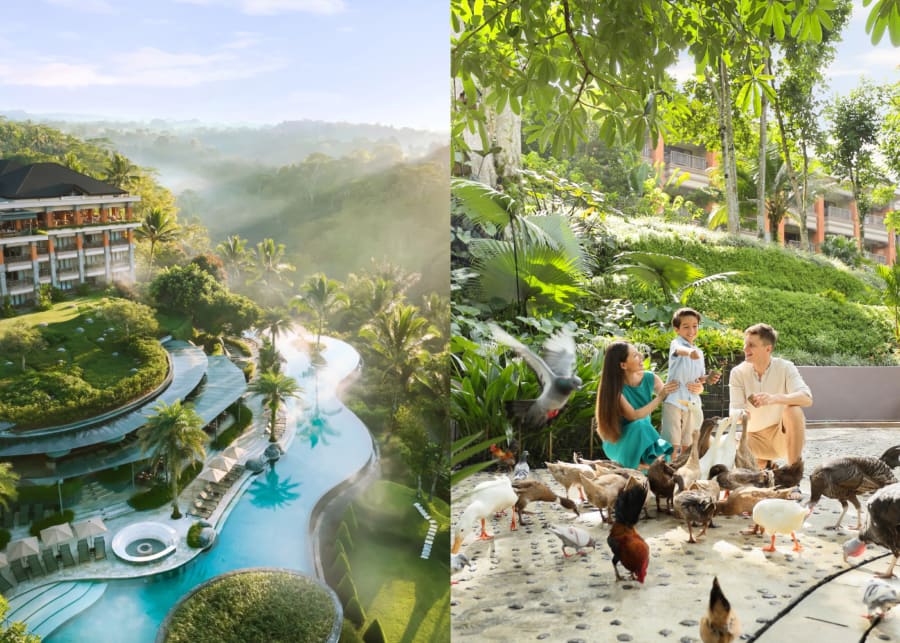
The drive north from central Ubud takes roughly forty-five minutes, winding through villages and past roadside warungs until the road climbs into Payangan. Here, perched on the edge of a river valley, Padma Resort Ubud unfolds across eleven hectares of jungle and cultivated garden. The scale alone is arresting: an eighty-nine-meter infinity pool that traces the valley's rim, heated and salt-chlorinated to accommodate Ubud's cooler evening air; rooms with floor-to-ceiling glass that frame the canopy; and an agroforestry garden where children can follow guides through rows of coffee, cacao, and tropical fruit.
What distinguishes this property is its commitment to free-range exploration. Families are encouraged to wander, to join village bicycle rides, to spend afternoons at the Animal Garden feeding deer, rabbits, ducks, turtles, cows, and goats. The supervised programming divides neatly by age: younger children gravitate toward arts and crafts in the standard play area, while those aged six to twelve graduate to the Kids Garden Club, where archery, fish feeding, and hands-on nature workshops occupy the hours. Parents, meanwhile, can slip away for morning yoga sessions in the open-air Bamboo Nest or linger over valley-view meals at Puhu Restaurant, which serves all-day dining without the need to venture beyond the resort gates.
There is an ease here, a sense that the property has been designed not to corral families into a single pool deck but to disperse them gently across a landscape that rewards curiosity. Rooms begin around 3.7 million Indonesian rupiah per night, according to Padma Resort Ubud, and the value proposition rests less on opulence than on space, safety, and the luxury of unstructured time.
Conrad Bali: The Architecture of Effortlessness
In Nusa Dua, where the coastline flattens into white sand and the sea turns a particular shade of turquoise, Conrad Bali has refined the mechanics of family hospitality into something close to art. The property offers Deluxe Family Rooms and interconnecting suites equipped with baby cribs on request, welcome gifts that include a plush monkey named Komang, and daily vouchers for complimentary gelato, a detail that speaks to the resort's understanding of what matters to traveling children.
The aquatic infrastructure is extensive: a thirty-five-meter main pool, a two-hundred-seventy-eight-meter lagoon that meanders through tropical gardens, and a shallow sand pool designed explicitly for safe splashing and sandcastle construction. Dining follows a similar logic of accommodation. All three on-site restaurants feature children's menus, and the breakfast buffet at SUKU includes a dedicated Kids Breakfast Corner stocked with pancakes, waffles, mini burgers, and iced chocolate.
Cultural programming is woven into the daily schedule at Kura Kura Kids Club, where Balinese dance lessons, kite-making, floral face painting, and traditional games occupy younger guests, while tailored activities are arranged for teenagers. The resort's Curators, a concierge team trained in experiential design, can organize family-friendly excursions such as participation in a Balinese full-moon ceremony, foraging walks in nearby nature reserves, or picnics by the resort's pond. Rates start around 6.8 million rupiah per night, according to Conrad Bali, positioning the property at the upper end of the family-resort spectrum but delivering a level of service that justifies the premium.
AYANA Bali: A Ninety-Hectare Ecosystem of Play
To describe AYANA Bali as large would be an understatement. The integrated resort sprawls across ninety hectares of clifftop terrain above Jimbaran Bay and comprises four distinct hotels, each with its own programming and aesthetic. For families, the decision often comes down to preference: RIMBA by AYANA emphasizes nature-led Jungle Adventure programs, while the suites at AYANA Resort itself lean toward timeless Balinese elegance and Ocean Adventure activities centered on the water.
What sets this property apart is not any single amenity but the totality of its infrastructure. Multiple pools equipped with waterslides. Indoor and outdoor playgrounds. The secluded expanse of Kubu Beach. AYANA Farm, where children can observe sustainable agriculture practices. SAKA Museum, which offers context on Balinese art and history. And because the estate is so vast, a complimentary shuttle and tram system operates continuously, eliminating the logistical friction that often accompanies large resorts.
The cultural programming here is both broad and deep. Balinese dress-up sessions. Canang-making workshops. Temple visits led by knowledgeable guides. Cooking classes that introduce children to the island's culinary traditions. There is also a Montessori-influenced educational component for younger guests and outdoor adventure camps designed for older children, a rare combination in the resort context. Rates begin around 5.5 million rupiah per night, according to AYANA Bali, and the value proposition is less about a single standout feature than about the cumulative effect of options, the sense that a family could spend a week here without exhausting the possibilities.
InterContinental Bali Resort: Five-Star Pragmatism in Jimbaran Bay
The beachfront location in Jimbaran Bay is the first point in InterContinental Bali Resort's favor. The second is the property's clear-eyed understanding of what families require: spacious, interconnecting rooms; baby cribs available on request; welcome gifts for children upon arrival; and kids' menus at every restaurant, including the more formal dining venues. Babysitting services are available for parents seeking solo time at the spa or an uninterrupted dinner.
The recently upgraded Planet Trekkers facility functions as both play zone and cultural immersion site. Inspired by Bali's natural landscapes, the air-conditioned space offers supervised activities that range from Balinese dance classes to craft workshops. Outdoors, the infrastructure includes a dedicated kids' pool, trampolines, and obstacle courses. Older children can enroll in surf lessons through the on-site Rip Curl School of Surf, a partnership that adds a layer of adventure to the standard resort experience.
What we appreciate here is the absence of pretense. This is not a property trying to reinvent the family-resort model. It is, instead, executing that model with precision, delivering the expected amenities, the reliable service, the sense that everything has been anticipated and quietly arranged. Rates start around 3.7 million rupiah per night, according to InterContinental Bali Resort, positioning it as a mid-to-upper-tier option with strong value relative to its offerings.
Hilton Garden Inn Bali Nusa Dua: Accessibility Without Sacrifice
There is a tendency, in luxury travel writing, to equate price with quality, to assume that the most expensive option is inherently the best. Hilton Garden Inn Bali Nusa Dua offers a useful corrective. Recently renovated and conveniently located near Bali Collection, the shopping, dining, and entertainment complex in Nusa Dua, this property delivers family-friendly infrastructure at a fraction of the cost of its five-star neighbors.
The King Deluxe Family Room includes a playful kids' tent and dedicated children's amenities. The on-site restaurant serves wholesome meals from a kids' menu and offers cooking classes open to both children and parents. Exclusive beach access is provided via an in-house shuttle, allowing families to move easily between the large outdoor pool, the poolside bar, and the sand. And notably, the property is home to the Hilton Garden Inn brand's first kids' club in the Asia Pacific region, a jungle-themed, air-conditioned indoor space equipped with Lego, stacking blocks, stuffed animals, gaming consoles, arts and crafts supplies, and a large-screen television for movie sessions. A rotating schedule of supervised activities, including storytelling and themed games, keeps children engaged throughout the day.
Rates begin around 1.2 million rupiah per night, according to Hilton Garden Inn Bali Nusa Dua, making this one of the most accessible family-oriented properties on the island without compromising on thoughtful design or cultural programming. For families seeking value without the attendant compromises that often accompany budget accommodations, this property merits serious consideration.
Mandapa, A Ritz-Carlton Reserve: The Temple of Slow Luxury
If the other properties on this list can be understood as resorts, Mandapa, a Ritz-Carlton Reserve, functions more as a sanctuary. Set along the Ayung River in the cultural heart of Ubud, the property offers butler-attended villas and suites, vintage Volkswagen convertible tours to nearby villages, rice fields, and temples, and dining at Kubu, the signature Mediterranean-European restaurant that has become something of a pilgrimage site for the island's food-focused travelers.
The Mandapa Camp tailors its programming to individual children, offering two-, four-, six-, or eight-hour sessions that encompass Balinese arts and crafts, music lessons, and games. An organic garden and a bamboo Kids Hut equipped with a slide and educational farm allow children to tend to on-site animals, grounding the experience in the rhythms of agrarian life. For children under five, parents are encouraged to participate alongside their young ones, a policy that reflects the property's broader philosophy: that luxury, at this level, is not about separation but about shared presence, about slowing down enough to notice the texture of a morning, the weight of a stone, the sound of the river below.
Rates begin around twenty million rupiah per night, according to Mandapa, positioning this property firmly in the ultra-luxury category. But for families seeking not just accommodation but a kind of temporal refuge, a place where the usual pressures of travel dissolve into something closer to ritual, the investment may well be justified.
The Question of Return
We have watched, over the years, as Bali's family-resort sector has matured. The island's appeal has always been its combination of natural beauty, cultural depth, and logistical ease, but the best properties have learned to go further, to design experiences that honor children's curiosity without reducing Balinese culture to a series of photo opportunities. They have learned, too, that parents traveling with children are not seeking constant stimulation but rather the conditions for genuine rest: space, safety, beauty, and the freedom to move at a pace determined by the family itself rather than by the resort's programming schedule.
The six properties we have profiled here represent different expressions of that understanding. Some lean toward adventure and scale. Others toward intimacy and cultural immersion. A few prioritize accessibility, proving that thoughtful design need not be the exclusive domain of five-star pricing. What they share is a recognition that family travel, done well, is not a compromise but an invitation, a chance to see a place through the eyes of those encountering it for the first time, to rediscover wonder in the ordinary, to remember why we travel at all.
Spot something wrong? Email editors@globalchicvoyage.com. We log every correction publicly.
RELATED
SEE ALL →
23 May 2026 / 5 min
13 Jul 2026 / 5 min
17 Jul 2026 / 5 min

27 Jun 2026 / 5 min