
Where Luxury Meets Latitude: A Return to the Maldives
After decades of watching hotel brands chase the horizon, we revisit the archipelago's finest addresses to understand what happens when paradise becomes plural.
SI
17 Jul 2026 · 5 MIN READ · UPDATED 17 AUG 2026
The Archipelago That Reinvented Arrival
There is a particular quality of light that exists only in the Maldives, a kind of luminous suspension between sky and sea that makes you question whether you've landed or simply floated into a more generous version of the world. We've watched this nation of coral atolls transform over the past two decades from a distant dream on American travelers' horizons into something closer to an obsession, a place where nearly every luxury hospitality group has planted its flag in the sand or, more accurately, built a boardwalk over crystalline water.
At Global Chic Voyage, we've returned to these islands repeatedly, notebook in hand, tracking the evolution of what has become one of the planet's most concentrated experiments in high-end hospitality. More than 180 resorts now populate the Maldives, each claiming its own slice of the infinite blue. Yet beneath the surface uniformity of overwater bungalows and private beaches lies a fascinating diversity of philosophy, a spectrum of approaches to the central question: what does paradise actually require?
When Wellness Becomes Architecture
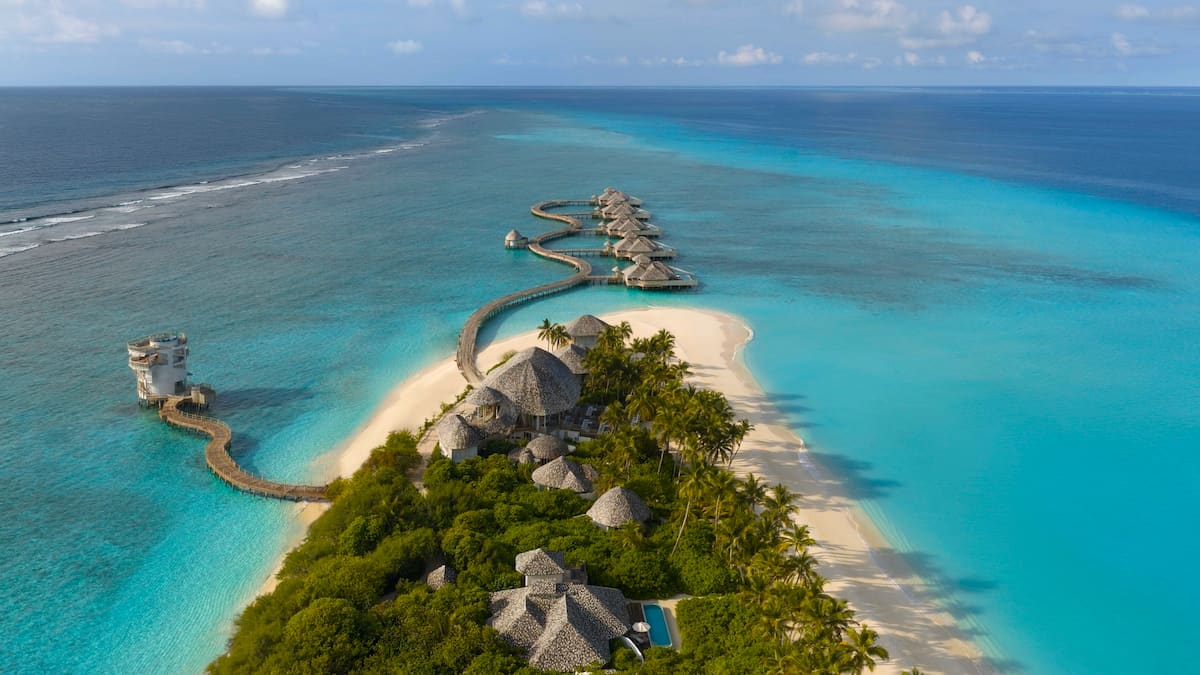
Some resorts answer that question by building wellness into their very bones. At Soneva Jani, 61 sprawling overwater villas stretch across a three-mile private island, each equipped with its own waterslide, that peculiarly joyful architectural gesture that collapses the distance between luxury and play. But it's the resort's approach to nourishment, both literal and metaphorical, that distinguishes it. More than a dozen restaurants focus on health without the usual ascetic deprivation, while two rooms offer unlimited ice cream and charcuterie, a kind of abundance that feels less like indulgence and more like trust in guests to find their own equilibrium.
Your Barefoot Guardian, the resort's answer to the traditional butler, operates on a "your wish is our command" philosophy that sounds extravagant until you realize it's simply radical hospitality stripped of the usual constraints. The Soneva Soul spa delivers treatments ranging from Ayurvedic massage to 24-karat gold facials, therapies that sound excessive until you're receiving them and they suddenly feel like exactly what your body has been requesting in a language you'd forgotten how to speak.
The Radical Act of Doing Nothing
Other properties have made an art form of subtraction. The Nautilus, tucked into Baa Atoll with just 26 villas, has abolished clocks and schedules entirely. This isn't marketing poetry but operational reality. Want caviar and pancakes at midnight? A private fireworks display? A picnic on a sandbank that will disappear with the afternoon tide? The resort's ethos treats time as a material to be shaped rather than a grid to be followed.
The interiors embrace a bohemian aesthetic that feels refreshingly unpolished for this tier of luxury: beaded chandeliers, macramé textiles, saturated colors that refuse the usual beige restraint of high-end hospitality. The nautilus-shaped pool becomes a sundial of sorts, marking the day's passage not in hours but in the changing quality of light on water. At the overwater Solasta Spa, three-hour treatments target not just muscle tension but existential states like stress and depleted immunity, as though the body were simply another clock in need of resetting.
Multi-Generational Excess
Then there are properties that have abandoned all pretense of restraint. .Here, which opened recently as a sister to Finolhu, consists of just nine villas split between two small islands named, with admirable directness, Nowhere and Somewhere. But to call them villas is to fundamentally misunderstand their scale. These are three to five-bedroom structures that span the entire width of their islands, one facade on the beach, the other on stilts above the lagoon, designed by London's Muza Lab with glass-bottomed pools large enough that you could lose a small child in them, metaphorically speaking.
The interiors explode with color in a way that feels deliberately anti-minimalist: seashell installations, bright bedrooms that refuse to fade into background. Most meals happen in the villas themselves, at one of several dining areas, or at Safar, the overwater restaurant that draws from dozens of culinary traditions, French lobster thermidor appearing alongside Thai green curry in a kind of edible world tour. At a minimum three-night stay starting above thirteen thousand dollars, the resort makes no apology for its excess. It simply offers it, take it or leave it.
Sustainable Crusoe
Not all luxury here announces itself with maximalism. Gili Lankanfushi, a short speedboat ride from the capital, has spent decades refining a "no news, no shoes" philosophy that now feels prescient rather than precious. One of the early practitioners of barefoot luxury, the resort built its 45 thatched-roof villas from repurposed materials and implemented a zero-plastic policy long before sustainability became a hospitality buzzword.
Yet even here, excess finds a foothold. The property's standalone overwater villa spans eighteen thousand square feet across four bedrooms, equipped with a private cinema, library, indoor gym, spa, two-story waterslide, and a pool that could host a small regatta. It's an interesting tension, this marriage of environmental consciousness and outrageous scale, as though the resort were asking whether sustainability and luxury are actually opposites or simply different languages describing care.
The Culinary Archipelago
For some travelers, paradise is best accessed through the palate. Waldorf Astoria Maldives Ithaafushi has committed to this philosophy with ten distinct dining venues, a number that sounds absurd until you realize it's actually a kind of culinary cartography. The floating Zuma represents the first of its kind globally, while the Ledge, helmed by a Michelin-decorated chef, serves improbably large cuts of grilled meat. At Yasmeen, Levantine dishes arrive in an Arabian-village setting that leans into theatrical design, while Terra suspends diners in hanging bamboo pods among the treetops, caviar in hand.
The resort will also craft sunken-sand dinners on the beach, tables nestled into excavated pits so that the horizon sits at eye level and the meal feels less like dining and more like a conversation with the ocean. It's hospitality as theater, yes, but theater in service of a genuine transformation in how you experience a place.
What the Atolls Teach
We've noticed, in our repeated returns to these islands, that the best properties share a common understanding: luxury in the Maldives isn't about importing opulence into a pristine setting but about creating the conditions for guests to shed whatever weight they arrived carrying. Whether through abundance or restraint, activity or stillness, each resort offers its own answer to the question of what people actually need when they finally have permission to stop.
The waterslides and private cinemas, the clocks removed from walls, the meals served in trees or sand, the spas that treat jet lag as a spiritual condition rather than a biological inconvenience, all of it represents a kind of hospitality that takes seriously the idea that luxury is ultimately about time and how you're allowed to spend it. In a world that increasingly feels like it's accelerating beyond human scale, these islands offer something increasingly rare: permission to move at the speed of light on water, which is to say, slowly, suspended, luminous.
Photo: Soneva
Spot something wrong? Email editors@globalchicvoyage.com. We log every correction publicly.
RELATED
SEE ALL →
27 Jun 2026 / 5 min
23 Jun 2026 / 5 min
18 Jun 2026 / 5 min
30 Jul 2026 / 5 min