
Where an Eight-Century Pond Garden Still Anchors Kyoto's Temple Quarter
At Four Seasons Kyoto, Shakusui-en is not a backdrop but the soul of the property, holding guests in its quiet orbit for a decade
YN
3 Jul 2026 · 5 MIN READ · UPDATED 17 AUG 2026
The Garden That Holds You
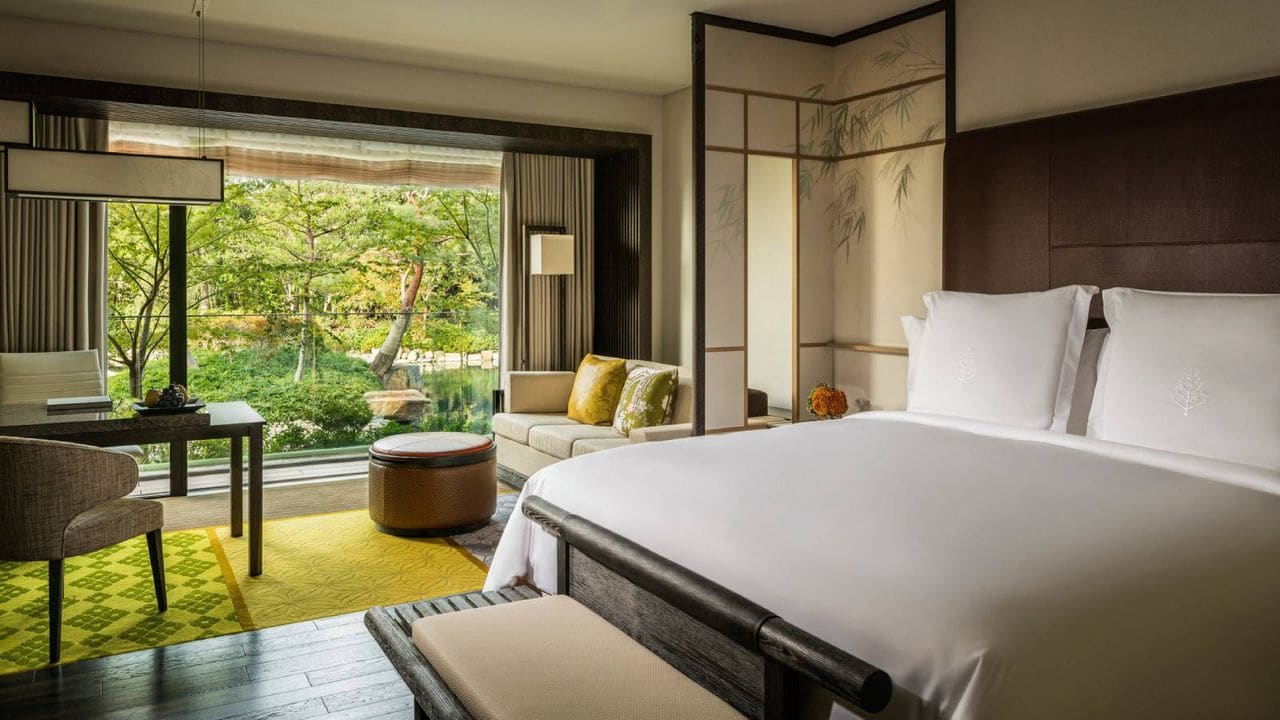
There is a moment, somewhere between breakfast and noon, when the koi surface in Shakusui-en and the light catches the water in a way that makes leaving seem like a tactical error. At Global Chic Voyage, we have watched travelers arrive at Four Seasons Kyoto with ambitious itineraries, only to find themselves rearranging temple visits and pottery studio appointments around the rhythms of this 800-year-old pond garden. A decade after opening at the foot of Higashiyama Mountain, the property has settled into something rare: a luxury hotel where the central attraction is neither the rooms nor the restaurants, but a heritage landscape believed to date to the late Heian period.
The hotel wraps around Shakusui-en like a careful frame. One hundred and eighty rooms, including thirteen suites and fifty-seven residential suites, face either the garden or the city beyond. Two restaurants, two lounges, a spa that spans one of Kyoto's largest wellness footprints, and a leather-clad Hermès rickshaw stationed in the lobby as if waiting for a guest who will never quite depart. This is architecture as edited restraint, where the loudest gesture is often the quietest: a glass bridge over ancient stonework, a tea house that shifts function with the daylight, seasonal blossom that arrives and recedes without announcement.
A District That Slows the Clock
Higashiyama is Kyoto at its most distilled. Narrow lanes thread between traditional machiya houses, temples rise from stone staircases worn smooth by centuries of pilgrims, and small artisanal shops operate on schedules that feel unbothered by the rest of the century. Kyoto Station sits roughly ten minutes away, close enough to make arrivals seamless but far enough that the temple district retains its particular atmosphere. The Kyoto National Museum and Kiyomizu-dera are within walking distance, though the hotel has a habit of derailing even the most disciplined sightseeing plans.
Weekly maiko performances unfold in the lobby, traditional apprentice geisha moving through choreography that has been refined over generations. The tea house, known as Fuju Lounge, hosts meditative tea ceremonies by day and transforms into a sake bar come evening, pouring expressions produced exclusively for the property alongside premium Champagne. Between the terrace overlooking the koi pond and the pull of the garden itself, leaving requires a surprising amount of resolve.
Design That Defers to Tradition
The architectural blueprint came from Japanese studio Kume Sekkei, while Hirsch Bedner Associates shaped the interiors across guest rooms, spa, and public spaces. The sense of arrival begins at the porte-cochère, designed by Jun Mitsui & Associates to echo traditional Japanese umbrellas, washi paper and glass softening the threshold between city and sanctuary. Inside, the scale shifts: quadruple-height ceilings in the dining room, cushions woven by Hosoo, a Kyoto atelier operating since 1688, and an art collection that includes Seven Stones by Tokyo-born sculptor Todo, assembled from rocks gathered from the pond garden itself.
Zen, a large blue work by Ofune Makoto, hangs as a meditation on the temple district, shifting seasons, and the particular calm that settles over Kyoto when the crowds thin. The interiors avoid the obvious gestures of luxury in favor of something quieter: warm wood, washi-paper lighting, soft screens, and palettes that feel like they borrowed their tones from the garden outside.
Rooms Built Around Kutsurogi
The Japanese concept of kutsurogi, or relaxation, governs the design of every room and suite. The garden-facing accommodations are the ones worth requesting: waking to Shakusui-en is less a view than an immersion, the pond and its surrounding landscape shifting with the light and the season. Even the more contemporary spaces remain tethered to Kyoto through material choices, restrained color, and an attention to detail that feels less like design and more like curation.
The residential suites function as apartments with hotel service, offering the scale and privacy that longer stays or families require. These are not rooms where you pass through; they are spaces designed to hold you, to slow the pace, to make the idea of staying in feel as compelling as venturing out into Higashiyama's alleyways.
Dining That Shifts with the Hour
Yamamoto Atelier designed the tea house, which serves dual purposes with the ease of a space that has always understood its own flexibility. By twilight, Fuju Lounge pours fine sakes, including expressions made exclusively for Four Seasons, alongside Champagne that pairs unexpectedly well with the garden's evening atmosphere. It is the ideal prelude to dinner at Sushi Ginza Onodera, the ten-seat restaurant where chef Takuya Kubo serves Edo-style sushi with the precision that tradition demands.
Kyoto Grill takes a different approach, operating as a brasserie-style restaurant across breakfast, afternoon tea, and dinner. Charcoal-grilled meats, dry-aged cuts, and seafood anchor the menu, though the space itself, with its soaring ceilings and views that dissolve into the garden, often upstages the plate.
A Spa That Draws on Ceremony
The wellness area stretches across one of Kyoto's largest hotel spa footprints. A twenty-meter indoor pool, Japanese ofuro baths, sauna, steam room, whirlpool, relaxation lounge, and twenty-four-hour fitness center sit alongside seven treatment rooms where protocols draw on Kyoto traditions and seasonal ingredients. The Heian Tradition ceremony layers matcha, bamboo charcoal salt, camellia oil, rice milk, honey compresses, a sake bath, and hot stones into a sequence that feels less like a treatment and more like a ritual.
The Zen Ceremony focuses on full-body massage with ginger-infused hot towels, extending into a sake bath for those who opt for the longer version. Sodashi treatments address jet lag and detox, while facials use Kotoshina, Biologique Recherche, and Tatcha. These are not quick fixes but immersive experiences, designed to occupy an afternoon rather than an hour.
The Architecture of Slowness
What makes Four Seasons Kyoto endure a decade in is not innovation but understanding. The hotel recognized early that Shakusui-en is not a backdrop to be admired from a distance but the central character, the reason guests return and the reason they stay longer than planned. The rooms are elegant without ostentation, the food is strong without spectacle, the spa is genuinely worth clearing a morning for, and the location places guests inside one of Kyoto's most atmospheric quarters without sacrificing quiet.
But it is the garden that holds the property together: koi surfacing in the pond, seasonal blossom arriving on its own schedule, a glass bridge connecting centuries, a tea house looking back toward the twelfth century. Kyoto's beauty and history, so often overwhelming in their density, become unusually manageable here. Not because they are simplified, but because they are framed with enough care that you can take them in without haste. The hotels we have returned to this year tend to share this quality: they understand that luxury, at its best, is not about abundance but about time, and the permission to spend it slowly.
Photo: Four Seasons Kyoto
Spot something wrong? Email editors@globalchicvoyage.com. We log every correction publicly.
RELATED
SEE ALL →
9 Jun 2026 / 5 min
2 Jul 2026 / 5 min

1 Jul 2026 / 5 min
30 Jun 2026 / 5 min