
Where Culture Lives Beyond the Shore: Nine Museums That Reveal Hawaii's Layered Past
From royal corridors to volcanic observatories, the archipelago's most compelling institutions invite travelers to pause, look closer, and understand the islands before they step onto the sand.
SI
27 Jun 2026 · 5 MIN READ · UPDATED 17 AUG 2026
The Problem With Paradise
There is a particular kind of amnesia that overtakes travelers the moment they land in Hawaii. The scent of plumeria, the weight of a lei, the impossible blue of the water - all of it conspires to erase context, to flatten five million years of geologic drama and two thousand years of Polynesian navigation into a backdrop for vacation photographs. At Global Chic Voyage, we have watched this happen season after season, in every resort corridor from Waikiki to Wailea. And we have come to believe that the most subversive thing a visitor can do in the islands is to spend an afternoon indoors, in the company of feather cloaks and lava samples and throne rooms that still smell faintly of koa wood and loss.
Hawaii's museums are not ancillary attractions. They are the archipelago's memory, its conscience, and increasingly its correction to a century of misrepresentation. To visit them is to understand that the word "aloha" carries weight far beyond a greeting, that sovereignty remains an open wound, and that the volcanoes beneath your feet are still writing the islands into existence. What follows is not an exhaustive list but a curated selection of nine institutions that have, in our repeated visits, proven themselves essential to any traveler willing to look beyond the postcard.
Iolani Palace: The Only Royal Residence on American Soil
You enter through gates that once bore the Hawaiian coat of arms, cross a courtyard where the Royal Hawaiian Band still performs on certain Fridays, and step into the only official state residence of royalty on United States territory. Iolani Palace, completed in 1882 under King Kalakaua, is a study in contradictions - a building that installed electric lights before the White House did, yet stood witness to the overthrow of a sovereign nation barely a decade later. The throne room, with its paired seats of koa and velvet, remains a place of pilgrimage for Native Hawaiians. The basement, where Queen Liliuokalani was imprisoned after the coup, is smaller than most hotel bathrooms. The docents speak in careful, measured tones, as if the walls are still listening.
We recommend the guided tour over the self-directed audio option. The narratives here are not neutral, nor should they be. This is a house that has been through occupation, near demolition, and painstaking restoration. To walk its halls without understanding the political architecture - the Bayonet Constitution of 1887, the Annexation of 1898, the Apology Resolution of 1993 - is to miss the point entirely. The palace does not offer escape. It offers reckoning.
Bishop Museum: The Smithsonian of the Pacific
If Iolani Palace is the heart of Hawaiian sovereignty, Bishop Museum is the archipelago's intellectual engine. Founded in 1889 to house the collection of Princess Bernice Pauahi Bishop, the last descendant of the Kamehameha dynasty, it has grown into the largest museum in the state and the premier institution for Polynesian natural and cultural history. The Hawaiian Hall, a three-story Victorian gallery lit by skylights and lined with koa cases, holds feather capes so densely worked that they shimmer like oil slicks, fishhooks carved from human bone, and genealogical chants that trace lineages back to the gods.
But the Bishop is not a mausoleum. Its planetarium offers navigational workshops based on wayfinding techniques used by the voyagers who first settled these islands. Its science wing houses live Hawaiian honeycreepers, some of the rarest birds on Earth. On weekends, kumu hula - traditional dance masters - perform in the courtyard, their movements a form of historical transmission more reliable than any written record. We have returned here half a dozen times over the years, and each visit surfaces something new: a temporary exhibition on taro cultivation, a lecture on the politics of repatriation, a case of stone adzes labeled with the names of the quarries from which they were hewn.
The museum is located in Honolulu's Kalihi district, away from the tourist core. This is intentional. To reach it, you must leave Waikiki behind, drive past residential streets where Hawaiian is spoken at bus stops, and acknowledge that the islands have a life beyond your itinerary.
Pearl Harbor National Memorial: The Archive of Rupture
Pearl Harbor is not, strictly speaking, a museum. It is a wound that has been turned into a shrine. The USS Arizona Memorial, which spans the submerged hull of the battleship that sank on December 7, 1941, is the most visited site in Hawaii, drawing more than a million people each year. The oil that still seeps from the wreck - nicknamed "the tears of the Arizona" - creates iridescent slicks on the harbor's surface, a reminder that the past is not inert. The memorial itself is a study in restraint: white concrete, open to the sky, designed by Honolulu architect Alfred Preis, himself a detained enemy alien during the war.
But the National Park Service has worked hard to expand the narrative beyond that single morning. The adjacent museums now include the Battleship Missouri, where Japan signed the instrument of surrender in 1945, and the USS Bowfin submarine museum. Together, they form a complex meditation on war, memory, and the ways in which catastrophe reshapes geography. The harbor itself, once a sacred fishpond and later a coaling station, is a palimpsest. Every layer tells a different story about power, strategy, and the islands' strategic location in the center of the Pacific.
Visitors should book tickets in advance; the memorial operates on a timed-entry system, and slots fill quickly. We also recommend arriving early enough to walk the onshore exhibits before boarding the Navy launch. The film shown in the theater is earnest, occasionally maudlin, but necessary. It establishes the emotional register. What the memorial itself offers is silence - a rare commodity in contemporary Hawaii.
Hawaii Volcanoes National Park: Jaggar Museum and the Volcano House Observatory
The Thomas A. Jaggar Museum, perched on the rim of Kilauea caldera, closed to the public in 2018 after the summit collapsed during that year's eruption. At the time of writing, the structure remains shuttered, its future uncertain. But the adjacent Volcano House and the makeshift interpretive displays set up by the National Park Service continue to serve as the archipelago's primer on vulcanology. Here, on the edge of one of the world's most active volcanoes, you can watch steam rise from fissures in real time, read seismographs that record the mountain's restlessness, and grasp, viscerally, that Hawaii is not finished. The islands are still being written, one lava flow at a time.
Before the closure, the Jaggar Museum held a collection of volcanic rock samples, historical photographs of eruptions dating back to the 1890s, and a working seismograph that clicked and scratched throughout the day like a geologic telegraph. The Park Service has promised a replacement facility, but no timeline has been set. In the meantime, rangers lead daily talks on volcanic formation, and the Volcano House - a historic lodge dating to 1846 - maintains a small gallery of artifacts and paintings. The experience is improvised, provisional, and all the more powerful for it. You are not observing geology from a safe distance. You are standing inside the process.
Honolulu Museum of Art: The Quiet Cosmopolitan
The Honolulu Museum of Art, formerly the Honolulu Academy of Arts, occupies a low-slung Mediterranean Revival complex in the Makiki Heights neighborhood, surrounded by monkeypod trees and frangipani. It is easy to overlook in a city dominated by beach culture, and that is precisely its charm. The collection, founded in 1927 by Anna Rice Cooke, spans five thousand years and six continents: Ming ceramics, Edo-period screens, European Old Masters, contemporary Hawaiian prints. The Asian galleries are particularly strong, reflecting the demographic makeup of the islands and the deep cultural ties between Hawaii and the Pacific Rim.
But the museum's most radical gesture is its architecture. Designed by Bertram Goodhue Associates, the building is organized around a series of open-air courtyards, each planted with species native to the region represented in the adjacent galleries. The Chinese courtyard has bamboo and lotus; the Mediterranean courtyard, olive and rosemary. The effect is synesthetic: you move through art history and botanical geography simultaneously, your senses engaged in ways that most climate-controlled museums never allow.
We have spent entire afternoons here, drifting between the Korean gallery and the Contemporary Pacific collection, stopping for lunch in the courtyard café. The museum also operates the Spalding House in the hills above the city, a midcentury estate turned sculpture garden with sweeping views of Diamond Head. Both sites are uncrowded, contemplative, and refreshingly free of the hard sell. This is culture as quiet luxury - a concept the islands understood long before the rest of the world caught up.
Lyman Museum and Mission House: Hilo's Cabinet of Curiosities
The Lyman Museum in Hilo is a time capsule, a Victorian-era natural history collection housed in a restored 1830s mission home. The geology wing holds one of the finest mineral and rock collections in the Pacific, including samples from every Hawaiian eruption of the past two centuries. The ethnographic galleries display calabashes, tapa cloth, and shell leis with hand-lettered labels that feel like relics themselves. Upstairs, the mission house is preserved exactly as it was when the Lyman family lived there, down to the patchwork quilts and the missionary press that printed the first Hawaiian-language Bibles.
Hilo, the island's east coast, sees far fewer tourists than Kona or Waikoloa. The Lyman Museum benefits from this neglect. It is a place where you can linger over a case of featherwork without jostling for position, where the docents remember your face if you return the next day. The museum also runs programs on Hawaiian quilting, traditional fishing techniques, and the history of immigration to the islands. These are not glossy, packaged experiences. They are community offerings, taught by practitioners who learned from their grandparents. The museum's modest scale is its greatest asset. It has not been optimized for throughput. It has been preserved for depth.
Kauai Museum: The Garden Island's Archive
The Kauai Museum, located in Lihue, occupies two historic buildings: the former county library and the adjacent Albert Spencer Wilcox Building. Together, they house the island's definitive collection of artifacts, photographs, and documents, from pre-contact fishhooks to plantation-era ledgers. The exhibits are old-fashioned in the best sense - dense with information, light on interactivity, unapologetic about requiring visitors to read. One gallery traces the island's role in early Hollywood, when directors came to shoot jungle scenes in the Waimea Valley. Another documents the devastating Hurricane Iniki of 1992, which reshaped the island's economy and ecology in a single night.
What makes the Kauai Museum essential is its commitment to specificity. This is not a generic "Hawaiian experience" but a granular account of one island's particular history - the taro farmers of Hanalei, the sugar dynasties of Koloa, the WWII-era military installations on the north shore. The museum also serves as a genealogical research center, helping descendants of plantation workers trace their family lines through immigration records. We watched, on one visit, as an elderly Japanese-American woman paged through passenger manifests from 1902, her finger trembling as she found her grandfather's name. That is the work museums do when they are embedded in their communities rather than performing for outsiders.
Bailey House Museum: Maui's Mission-Era Window
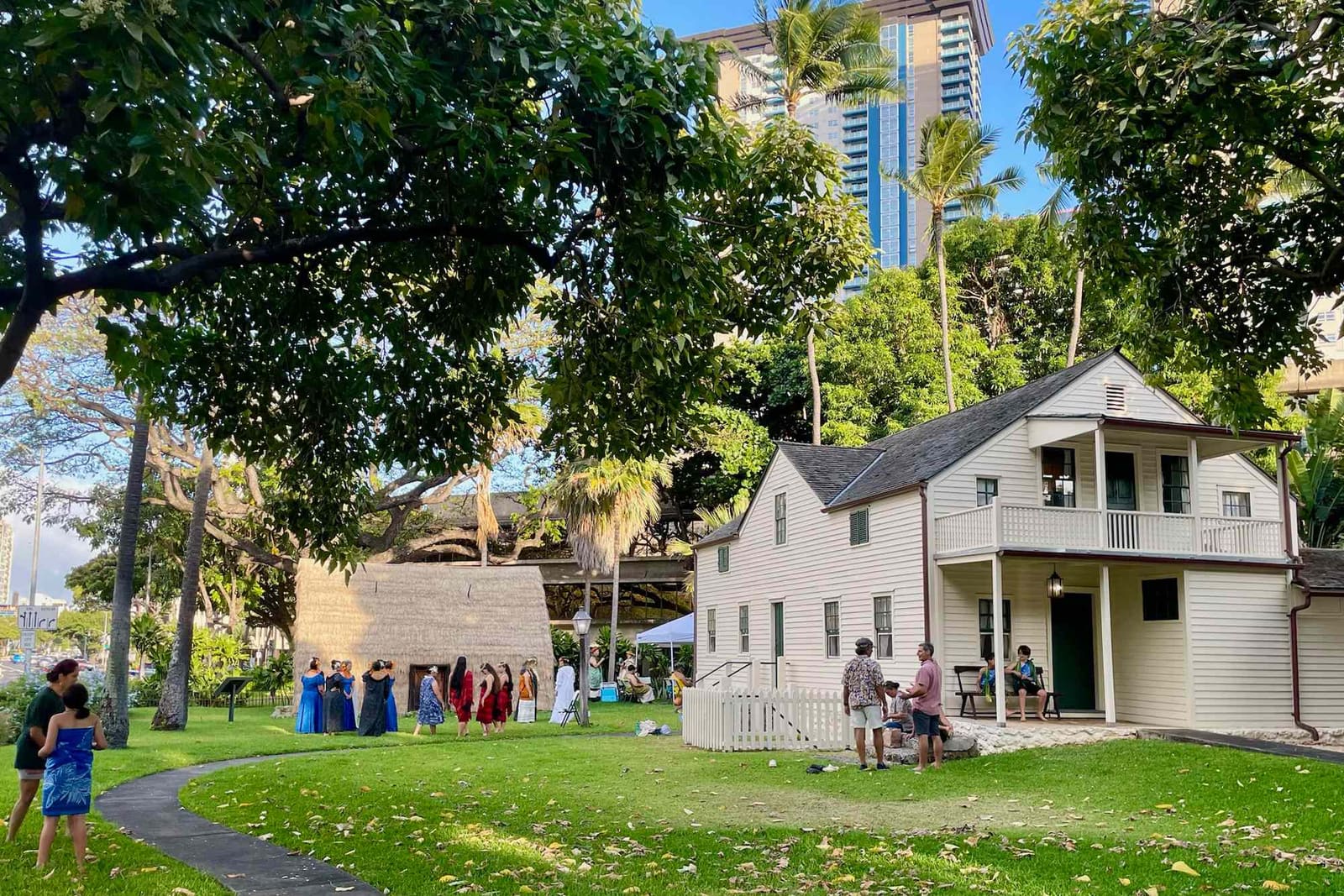
The Bailey House, a coral-block structure in Wailuku built in 1833, served as the Wailuku Female Seminary and later as the home of Edward and Caroline Bailey, New England missionaries who spent five decades in the islands. Today it functions as the Maui Historical Society's headquarters and museum, with galleries devoted to pre-contact Hawaiian life, missionary material culture, and the paintings of Edward Bailey, who documented Maui's landscapes with the precision of a surveyor and the eye of a romantic.
The museum's collection of Hawaiian artifacts - stone poi pounders, wooden images, sharktooth weapons - was assembled in the nineteenth century, when such objects were still in use. This lends the collection an immediacy that later, more "scientific" acquisitions often lack. These were not specimens. They were tools, ritual objects, possessions. The Bailey House also maintains a traditional Hawaiian garden, planted with kalo, ulu, and medicinal herbs, and offers workshops on lei-making and lauhala weaving. It is a small institution, run on a modest budget, but it does not apologize for its scale. It knows what it is: a local archive that happens to welcome visitors, rather than a visitor attraction that tolerates locals.
Pacific Aviation Museum: The Machinery of War and Wonder
The Pacific Aviation Museum, located on Ford Island in the middle of Pearl Harbor, occupies two massive hangars that survived the 1941 attack. Hangar 37 still bears bullet holes in its walls, and the museum has left them unrepaired. The collection includes a B-25 bomber, a Japanese Zero, and the actual control tower from which the first reports of the attack were radioed. But the museum is not merely a shrine to military aviation. It also documents Hawaii's role in the development of commercial flight, from the early Pan Am Clippers that made Honolulu a Pacific hub to the modern inter-island carriers that stitch the archipelago together.
The museum's restoration workshops are open to visitors, and watching volunteers painstakingly rebuild a 1940s-era fighter is to witness a peculiar form of devotion. These are not professional conservators but retired engineers, pilots, and hobbyists who believe that the machines deserve to live. The museum also offers flight simulators and cockpit tours, which are popular with children and aviation enthusiasts. But the quieter pleasure is walking the length of Hangar 79, beneath the suspended aircraft, and considering the strange fact that Hawaii's modern identity was forged as much by airplanes as by outrigger canoes.
Why We Keep Returning
Museums in Hawaii are not neutral spaces. They are sites of contestation, recovery, and translation. They ask visitors to slow down, to read the fine print, to acknowledge that the islands have a history that predates and exceeds the tourist economy. Some of them, like Iolani Palace, make that demand explicit. Others, like the Honolulu Museum of Art, offer it as an invitation, a side door into deeper engagement. But all of them share a common premise: that understanding a place requires more than looking at it. It requires listening to the stories the place tells about itself, in its own voice, on its own terms.
We have watched, over the years, as Hawaii's museums have become more confident in their narratives, less willing to soften the edges of history for the comfort of outsiders. This is not hostility. It is respect - for the visitor's intelligence, for the complexity of the past, and for the communities whose lives continue to unfold in the shadow of that past. To spend time in these institutions is to be reminded that the islands are not a fantasy. They are a place, with all the weight and contradiction that word implies. And the best museums in Hawaii understand that the most generous thing they can offer is not escape, but presence.
Spot something wrong? Email editors@globalchicvoyage.com. We log every correction publicly.
RELATED
SEE ALL →
21 Jul 2026 / 5 min
7 Jul 2026 / 5 min
8 Aug 2026 / 5 min
7 Aug 2026 / 5 min