
Where Denim Meets Wagyu: A Toronto Steakhouse Wrapped in Indigo
Shinji reimagines the Japanese steakhouse through the unlikely lens of workwear, trading spectacle for restraint in the heart of the Financial District.
ML
23 Jul 2026 · 5 MIN READ · UPDATED 17 AUG 2026
A Fabric as Metaphor
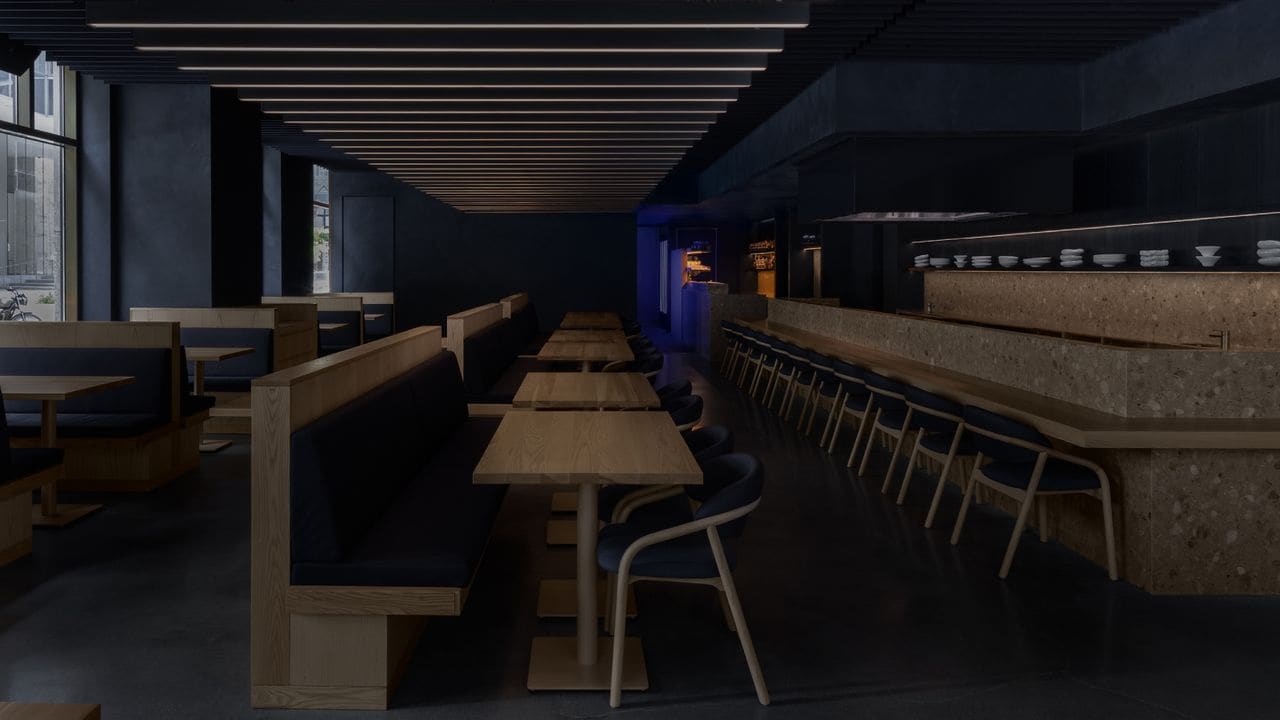
There's a moment, descending the dark-stained wood ramp into Shinji, when the walls seem to shift from architectural surface to something closer to cloth. The indigo limewash has been applied by hand in thin, overlapping layers until it reads less like paint and more like the memory of dyed fabric, saturated and uneven in the way only natural materials are. It's an unusual entry for a steakhouse, but then Shinji was never meant to announce itself with the usual signifiers.
The restaurant occupies the base of the West Tower at Bay Adelaide Centre, where a 1920s heritage shell sits tucked beneath one of Toronto's newest office towers. Harlo Entertainment, the group behind Mimi Chinese and Sunny's Chinese, approached Toronto studio Odami with a brief that sidestepped the expected: create a modern Japanese steakhouse that feels rooted in something real, not referential. Founders Arancha González Bernardo and Michael Fohring landed on denim as their conceptual anchor, drawn to its ability to inhabit both the utilitarian and the refined. "It is equally at home in workwear and high fashion," Fohring notes, "and that balance between humility and refinement became the conceptual lens through which we approached the entire project."
At Global Chic Voyage, we've long believed that the most compelling dining spaces are those that resist easy categorization, and Shinji's material restraint, its refusal to lean on bamboo or paper screens, marks it as one of the more thoughtful interiors we've encountered this year.
The Architecture of Arrival
Rather than flatten the existing ramp into mere circulation, Odami enclosed it in acoustic panelling and transformed it into a threshold, a deliberate slowing before the dining room proper. The ceiling and walls are coated in that custom indigo limewash, applied until the surface holds depth, the kind of richness you associate with ink or natural dye rather than industrial finish. Overhead, navy felt baffles absorb the clatter of a full service while echoing the warp and weft of woven denim, though the reference is oblique enough to avoid literalism.
The palette throughout is restrained: shades of blue-black, charcoal, walnut, and the warm glow of low-hung pendants that pool light over tables rather than flooding the room. It's a strategy we've seen work well in Tokyo's more subdued kaiseki-ya, where the architecture recedes to let the food and the ritual of service take center stage. Here, the effect is similar: the space holds you without demanding attention.
The one moment of levity arrives not in the dining room but in the corridor leading to the washrooms, where pink neon bleeds into view gradually, a wink at Japan's late-night izakaya culture. It's kept apart, a surprise reserved for those who go looking, and it underscores the design's larger sensibility: restraint punctuated by intention.
Craft Over Spectacle
In the kitchen, executive chef and partner Jia Zou, who honed his approach at Miku and Kasa Moto, has built the menu around Shinji's central grill. The à la carte selection spans raw preparations, nigiri, and a full range of Japanese wagyu graded from A3 to A5, sourced directly from Iwate, Miyazaki, Hokkaido, and Kagoshima. True Kobe beef, brought in from Hyogo prefecture, anchors the top end of the offering. For diners seeking a more guided progression, there's a chef's choice menu and a dedicated omakase experience at the counter.
Fish, shiso flower, and kinome leaf arrive from Japan several times a week, a logistical commitment that signals Zou's preference for proximity to source over compromise. The kitchen's philosophy mirrors the design's: no shortcuts, no approximations. Start with the A5 wagyu, ordered by the ounce and grilled to order, or the Shinji surf and turf, a pairing of black cod and sliced wagyu finished with yakiniku sauce and crispy leeks. Zou describes it as "the single bite that captures the restaurant's dual identity most efficiently," and it's not an overstatement. The dish balances richness with brightness, fat with acidity, in a way that feels both indulgent and considered.
The shared-plate format encourages a kind of communal pacing, a rhythm that rewards lingering. We've noticed, across the luxury dining rooms we've returned to this year, a quiet shift away from the theater of tasting menus toward something more flexible, more conversational. Shinji's approach, with its emphasis on craft and direct sourcing, feels aligned with that broader evolution.
A Steakhouse Without Swagger
What strikes us most about Shinji is what it chooses not to do. There's no performative tableside service, no dramatic reveal of marbled cuts under glass, no attempt to overwhelm with volume or spectacle. Instead, the restaurant trades in understatement: the slow reveal of the ramp, the muted palette, the careful sourcing, the neon surprise held in reserve. It's a sensibility that feels more aligned with the quiet confidence of Japanese craft traditions than with the bravado often associated with North American steakhouses.
The denim metaphor, which could have felt precious or forced, instead provides a through-line that makes sense of the design choices. Like a well-worn pair of jeans, the space feels both functional and refined, capable of holding up under scrutiny without calling attention to itself. And in a city where Japanese dining has become increasingly visible, Shinji carves out a position that feels distinct: less about spectacle, more about substance, with enough wit to keep things from sliding into austerity.
For those traveling through Toronto with an appetite for something beyond the expected, Shinji offers a meal that lingers not because it shouts, but because it knows when to whisper.
Credit: John Alunan
Spot something wrong? Email editors@globalchicvoyage.com. We log every correction publicly.
RELATED
SEE ALL →
16 Jul 2026 / 5 min
21 Jun 2026 / 5 min
15 Jul 2026 / 5 min
7 Aug 2026 / 5 min