
Inside Hermès's Six-Storey Georgian Maison on Bond Street
London's newest luxury landmark weaves British heritage with Parisian savoir-faire across 55 rooms of handcrafted interiors
SI
28 Jun 2026 · 5 MIN READ · UPDATED 17 AUG 2026
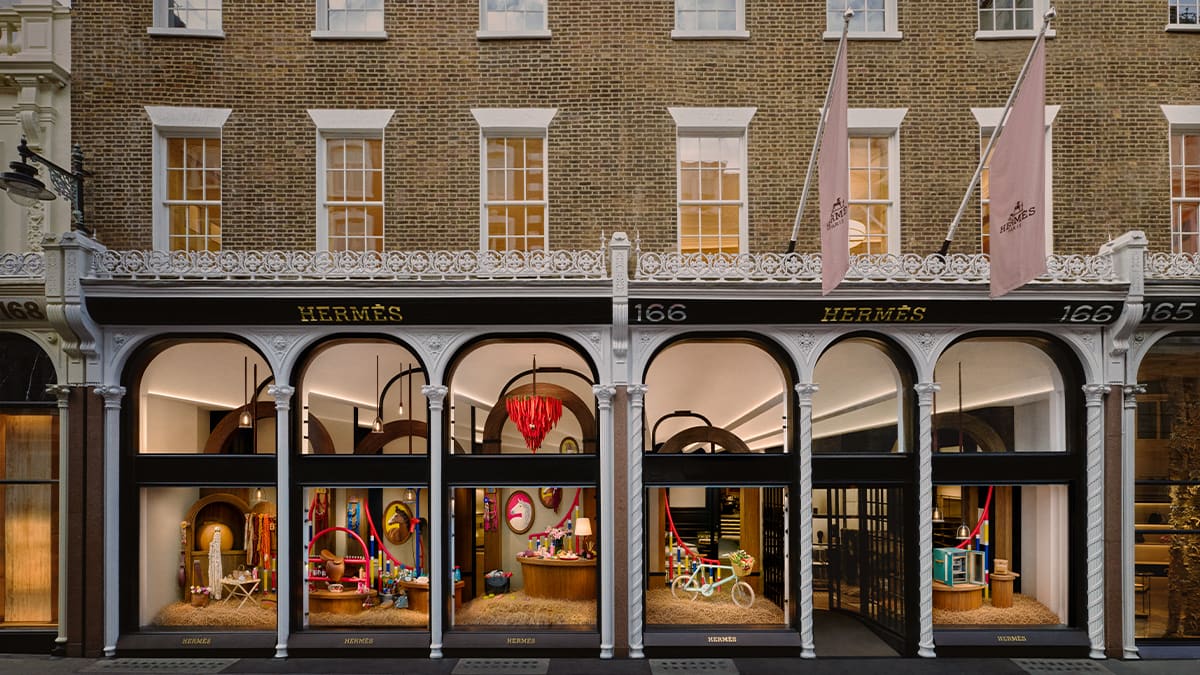
A Parisian House Returns to Its British Roots
There's a particular quality of afternoon light that slants through Georgian windows in Mayfair, catching dust motes and gilt frames in equal measure. Step inside number 166 New Bond Street and you'll find that light playing across handcrafted marquetry, illuminating restored Victorian mosaics, and pooling on limestone floors worn smooth by two centuries of footfall. Hermès has taken six Grade II listed townhouses, structures that once sheltered another storied luxury name for more than 150 years, and reimagined them as something rarer still: a retail environment that feels less like a temple to commerce and more like a private collection opened to the public.
At Global Chic Voyage, we've watched luxury brands chase ever-larger footprints in the world's most expensive retail corridors. But scale alone rarely translates to atmosphere. What Hermès has achieved here, across five floors and more than 21,000 square feet, is a study in how architectural restraint and artisanal excess can coexist without contradiction.
The Architecture of Restraint
Paris-based studio RDAI, under the direction of Denis Montel, approached the interiors with a philosophy that artistic director Pierre-Alexis Dumas describes as distinctly Anglo-French. The brief was never to impose a Parisian template onto a London address, but rather to excavate what Hermès calls its "British soul," a lineage rooted in 19th-century equestrian craft and saddlery traditions that first shaped the house's identity.
The result is a spatial experience that unfolds in layers. Fifty-five rooms are threaded together by three lifts and four staircases, the most arresting of which is a spiral originally conceived by Foster + Partners and extended during the recent renovation. Navigation becomes part of the pleasure: you might enter seeking a silk scarf and find yourself, three turns later, in a gallery-like chamber lined with 18th-century street signage advertising velocipedes and haberdashery, relics discovered during construction and woven into the interior narrative.
More than 50 artisans contributed to the fit-out, from specialist glassworkers to craftsmen restoring original mosaics unearthed beneath layers of later renovations. The effect is cumulative rather than showy. Walk through and you notice the grain of a bespoke console before you register its function, the way a decorative wall treatment catches shadow before you understand it as pattern.
Curating a Sense of Place
Hermès installed 500 artworks throughout the maison, each selected by Dumas for this specific address. The curation leans heavily into British visual culture without tipping into pastiche: equestrian portraits, botanical studies, architectural etchings. These aren't merely decorative gestures. They anchor each room in a narrative that connects the house's French origins to the British craft traditions it has long admired and absorbed.
The interiors avoid the trap of period re-creation. Instead, RDAI has layered contemporary interventions, modern lighting, sleek display cases, against the bones of these 18th-century structures. It's a dialogue rather than a monologue, and it gives the space a lived-in quality that many luxury flagships, for all their investment, struggle to conjure.
The Métiers on Display
Every category Hermès produces finds expression here: leather goods and saddles, silk scarves and ties, jewelry, watches, homeware, ready-to-wear for men and women. But the merchandising never feels relentless. Rooms are scaled to suggest domestic interiors rather than showrooms, with pieces arranged as though a particularly discerning collector had simply left them out for guests to admire.
This approach reflects a broader shift we've observed in how heritage houses are rethinking flagship retail. The goal is no longer maximum product density per square foot, but rather the creation of environments where clients linger, where discovery feels serendipitous rather than algorithmic. In an age when nearly anything can be ordered online, the physical store must offer something the screen cannot: atmosphere, texture, the pleasure of being somewhere rather than merely buying something.
Intuition Over Strategy
Hermès acquired the property in 2009 for 75 million pounds, a significant outlay even by the standards of New Bond Street, where rents rival those of any luxury corridor on earth. The renovation has taken the better part of two decades from purchase to unveiling, a timeline that speaks to the company's willingness to privilege craft over speed.
CEO Axel Dumas framed the project in explicitly generational terms: purchased by the sixth generation of the family for the seventh. It's a philosophy that runs counter to the quarterly earnings cycles and rapid-refresh strategies that dominate much of the luxury sector. "We tried to work mostly from intuition, desire, and not a strategy," Axel Dumas noted at the opening, a statement that would sound naïve from almost any other luxury executive but rings true from a house still governed by family control and artisanal values.
The Bond Street Context
New Bond Street occupies a peculiar position in the global luxury landscape. It lacks the architectural grandeur of Avenue Montaigne or the theatrical scale of Fifth Avenue, yet it has remained, for three centuries, the address where London's wealthiest and most discerning clients come to shop. Chanel, Louis Vuitton, Cartier, Bulgari: the roll call of neighboring flagships reads like a who's who of European luxury.
Hermès's arrival, or more accurately its expansion into this specific set of buildings, carries symbolic weight. The houses were occupied by Asprey from 1847 until Hermès's acquisition, making them one of the longest continuously operating luxury retail sites in Britain. To inherit such a lineage is to accept a custodial responsibility, one that extends beyond merchandising to the preservation of architectural and cultural heritage.
The maison's interiors honor that legacy without being imprisoned by it. Restored elements sit alongside contemporary insertions, creating a palimpsest effect where multiple eras coexist. It's an approach that mirrors the broader narrative Hermès has cultivated: a house rooted in tradition but unafraid of evolution, as comfortable commissioning experimental artists as it is maintaining centuries-old leatherworking techniques.
A Maison for the Long View
What strikes most forcefully about the Bond Street maison is its refusal of easy spectacle. There are no sweeping atriums flooded with Instagram-ready light, no monumental staircases designed primarily for social media documentation. Instead, the space rewards slow exploration, the kind of unhurried browsing that has become increasingly rare in luxury retail.
This is architecture and curation in service of a particular vision: that a flagship store can be more than a point-of-sale, that it can function as a physical embodiment of a brand's values, a three-dimensional argument for why craft and patience and historical continuity still matter in an accelerating world. Whether that vision translates to commercial success is, in some sense, beside the point. Hermès has always operated on a longer timeline than its competitors, prioritizing brand equity and artisanal integrity over short-term market share.
The Bond Street maison, with its labyrinthine layout and layered references, offers a compelling counter-narrative to the homogenization that has flattened so much of luxury retail into interchangeable marble-and-glass temples. Here, place and history and craft converge into something that feels both specific to London and unmistakably Hermès, a rare synthesis in an industry too often content with formula.
Spot something wrong? Email editors@globalchicvoyage.com. We log every correction publicly.
RELATED
SEE ALL →
8 Aug 2026 / 5 min

7 Aug 2026 / 5 min

31 Jul 2026 / 5 min

31 Jul 2026 / 5 min