
The Aquamarine Dream Hidden Between Utah and Idaho
Bear Lake's improbable turquoise waters have earned it a nickname borrowed from warmer latitudes - and a second look from travelers weary of the obvious.
CG
21 Jun 2026 · 5 MIN READ · UPDATED 17 AUG 2026
A Color That Shouldn't Exist Here
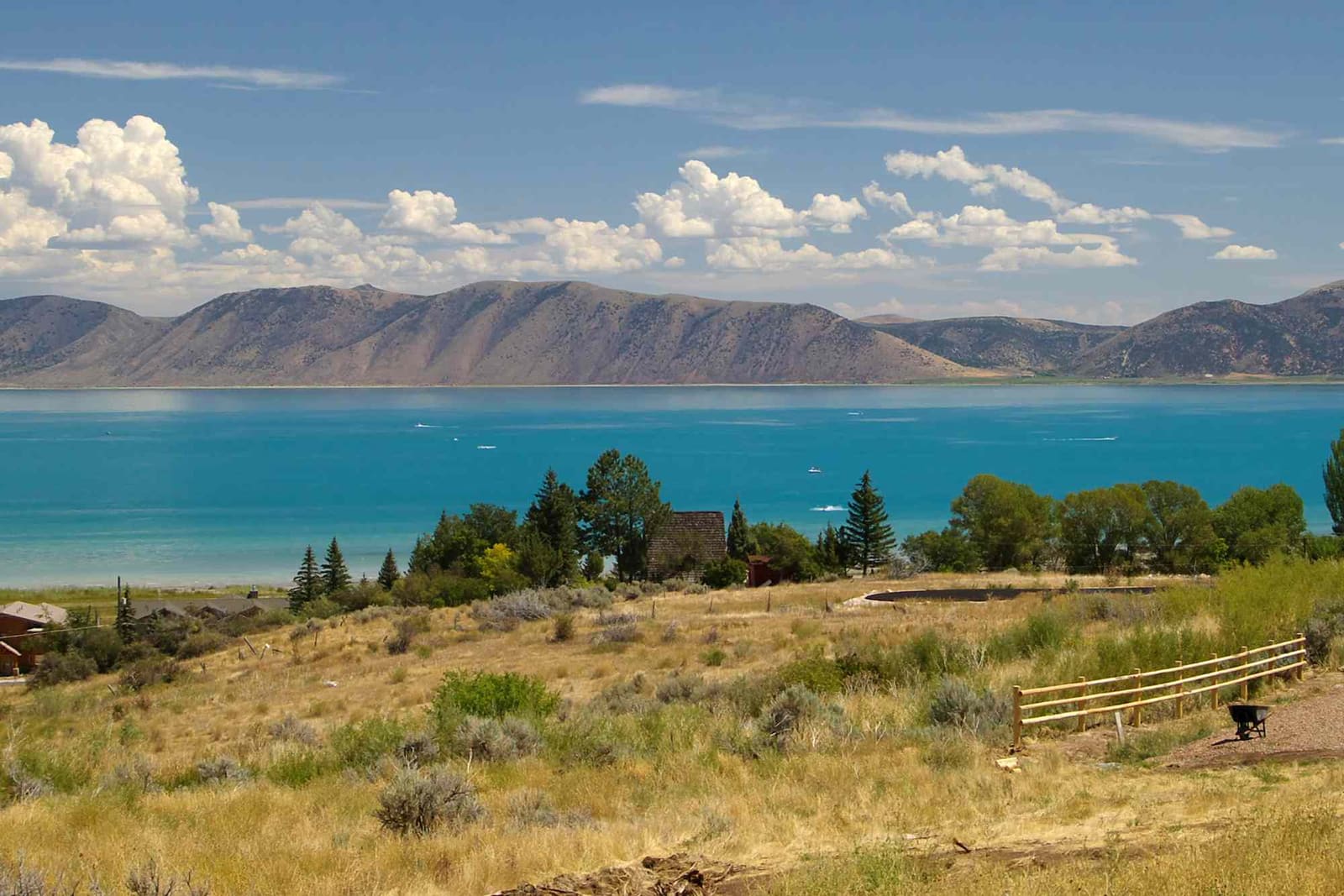
There is a moment, as you crest the final ridge and the valley opens below, when the mind refuses what the eyes insist upon. Water that shade of turquoise - lambent, almost chemical in its intensity - belongs to coral atolls and limestone cenotes, not to the high country of the American West. And yet there it lies, twenty miles long and eight across, cradled between sagebrush hills and the distant serrations of the Bear River Range: Bear Lake, straddling the Utah-Idaho border at nearly six thousand feet, wearing a color borrowed from latitudes two thousand miles south.
Locals have long called it the Caribbean of the Rockies, a nickname that sounds like Chamber of Commerce hyperbole until you stand on its shore. The comparison is imperfect - there are no palms here, no reef fish, no trade winds - but the aquamarine glow is real, startling, and for those of us who have spent years chasing water in all its moods, genuinely arresting. At Global Chic Voyage, we've watched this lake move quietly from regional secret to something approaching cult status among a certain breed of traveler: the kind who prizes the uncrowded, the geologically odd, the place that makes you recalibrate your assumptions about what a landscape can do.
The Science Behind the Shimmer
The color, as it turns out, is no accident. Bear Lake owes its improbable hue to limestone sediments suspended in the water column - calcium carbonate particles so fine they scatter sunlight in precisely the wavelengths that register as turquoise to the human eye. The effect intensifies on bright days, when the sun is high and the wind stills, and the surface takes on the polished, saturated quality of a gemstone held to the light.
It is a phenomenon shared by only a handful of lakes worldwide: Peyto Lake in the Canadian Rockies, certain crater lakes in New Zealand, a few glacial tarns in the Alps. But Bear Lake achieves this alchemy without glacial melt, without volcanic minerals, without any of the usual geological theatrics. The limestone comes from ancient seabeds, laid down when this corner of the West was submerged beneath a vast inland sea. Millennia of erosion have ground those beds to powder, and the lake, fed by springs and streams that percolate through the stone, carries the residue in suspension - a kind of liquid memory of deep time.
For the visitor, the science matters less than the visceral response. You come expecting another mountain lake, blue or green in the conventional sense, and instead encounter something that reads as tropical, even surreal. It is disorienting in the best way, a reminder that the planet still holds surprises within a few hours' drive of major cities.
Where Two States Meet Water
Bear Lake occupies a liminal geography, split nearly down the middle by the Utah-Idaho state line. The division is arbitrary - the water pays it no mind - but it has shaped the human overlay in subtle ways. The Utah side, anchored by the small resort town of Garden City, leans slightly more developed, with a scattering of lodges, marinas, and seasonal ice cream shops famous for their raspberry shakes, made from berries grown in the microclimate of the valley. The Idaho side remains quieter, more given over to state parks and stretches of undeveloped shoreline where the only footprints are your own.
We favor the northern reaches, where the lake narrows and the hills press closer. Here the water deepens to a shade somewhere between jade and sapphire, and the silence is broken only by the occasional call of a pelican or the slap of a kayak paddle against the surface. There are no grand resorts, no curated experiences - just the raw fact of the lake and the land that holds it.
The region has long been a summer retreat for families from Salt Lake City and Boise, a place of modest cabins and multi-generational traditions. But in recent years, a different kind of traveler has begun to appear: the photographer chasing that perfect gradient of light on water, the writer seeking a week of solitude, the couple who have done the coasts and the canyons and now want something less scripted. Bear Lake offers that. It does not announce itself. It simply exists, radiant and self-contained, and you either stumble upon it or you seek it out.
Activities Beyond the Obvious
Swimming, of course, is the default pleasure - the water in summer warms to a surprising seventy degrees, far more hospitable than the snowmelt-fed lakes of higher elevations. The shallow bays along the eastern shore are ideal for wading, the bottom sandy and gradual, the color at its most saturated in the late afternoon when the sun slants low.
But the lake rewards slower, more contemplative engagements. Stand-up paddleboarding at dawn, when the surface is glass and the surrounding peaks emerge from shadow, offers a kind of moving meditation. Sailing is popular among the local cognoscenti, the wind predictable and the fetch long enough to build a satisfying chop. In winter, when the lake freezes, a different community appears: ice fishermen, their shelters dotting the white expanse like a temporary village, pursuing the native Bonneville cisco - a relic species left behind when the ancient Lake Bonneville receded ten thousand years ago.
We have returned to Bear Lake in all four seasons, and each offers its own logic. Summer is exuberant, the shores busy with families and the water alive with boats. Autumn is contemplative, the hills turning rust and gold, the crowds thinning to near-nothing. Winter is stark and strange, the frozen lake a vast silence under snow. Spring is unpredictable - ice-out comes late, and the melt turns the access roads to mud - but the light in May, when the wildflowers bloom and the water begins to warm, is among the finest we have seen anywhere in the Rockies.
The Raspberry Cult and Other Local Traditions
No visit to Bear Lake is complete without an encounter with the raspberry. The valley has been growing them since the late nineteenth century, when Mormon settlers discovered that the microclimate - sheltered, sunny, with just enough chill in winter - produced berries of unusual sweetness and intensity. The harvest runs from late July through August, and during those weeks, every roadside stand and diner offers the same litany: raspberry shakes, raspberry jam, raspberry pie, raspberry everything.
It is easy to dismiss this as tourist kitsch, and some of it is. But the best versions - thick, tart, made from fruit picked that morning - are genuinely excellent, a taste of place as specific as any you will find. We recommend the original LaBeau's in Garden City, a no-frills counter operation that has been making shakes since the 1940s and has not changed the recipe or the decor in the intervening decades.
Beyond the berries, the food culture here is modest, leaning toward hearty American diner fare and the occasional fish fry featuring lake trout or cisco. This is not a destination for culinary pilgrimage, but for those who appreciate regional foodways and the quiet persistence of family-run businesses, it offers its own rewards.
How to Approach Bear Lake
Access is straightforward. From Salt Lake City, the drive takes roughly two and a half hours, heading north through Logan and over the mountains into the Bear Lake Valley. From Idaho Falls or Pocatello, the approach is slightly longer but equally scenic, winding through farmland and sagebrush steppe before the lake appears, sudden and luminous, in the distance.
Accommodations range from basic campgrounds - Bear Lake State Park on the Utah side has well-maintained sites with lake access - to modest motels and vacation rentals in Garden City and nearby Laketown. This is not luxury lodging country, and that is part of the point. The focus remains on the lake itself, on the quality of light and water, on the pleasure of a place that has not yet been overly curated or packaged for mass consumption.
Timing matters. Summer weekends, particularly around the Fourth of July and the annual raspberry festival in August, see crowds that can strain the small-town infrastructure. We prefer the shoulder seasons - late May and early June, or September into early October - when the weather is still cooperative, the water swimmable or nearly so, and the sense of discovery intact.
For those inclined toward solitude, consider the western shore, accessible via a network of dirt roads that require a vehicle with reasonable clearance but reward the effort with empty beaches and unobstructed views. Bring a kayak or a paddleboard if you have one; the launches are informal, often just a pull-off and a slope of gravel, but the freedom to explore the shoreline at your own pace is worth the logistics.
What the Lake Teaches
There is a paradox at the heart of Bear Lake's appeal. It is beautiful, yes - strikingly so - but beauty alone does not explain the hold it exerts on those who return year after year. What the lake offers, we think, is a kind of permission: to slow down, to dispense with itinerary, to spend an afternoon doing nothing more than watching the light shift across the water.
In an era when travel often feels like a checklist, a race to see and photograph and move on, Bear Lake insists on a different tempo. There are no UNESCO sites here, no Instagrammable landmarks, no influencers crowding the frame. There is only the lake, the hills, the sky - and the quiet satisfaction of a place that remains, for now, largely itself.
We think of it as a corrective, a reminder that some of the most rewarding destinations are the ones that ask little of you beyond presence. The Caribbean of the Rockies is a charming nickname, but it undersells the reality. This is not a pale imitation of somewhere else. It is Bear Lake, singular and sufficient, a high-altitude jewel that happens to wear the wrong color for its elevation - and is all the more compelling for it.
The travelers we know who have made the pilgrimage tend to guard the secret lightly, mentioning it only to kindred spirits, the ones who understand that the best places are often the ones you have to seek out, the ones that do not shout. Bear Lake does not shout. It simply glows, turquoise and patient, waiting for those ready to see it.
Spot something wrong? Email editors@globalchicvoyage.com. We log every correction publicly.
RELATED
SEE ALL →
8 Aug 2026 / 5 min
7 Aug 2026 / 5 min
31 Jul 2026 / 5 min
31 Jul 2026 / 5 min