
When the Stand-In Steals the Show: Vis and the Art of the Cinematic Double
A Croatian island carved its own identity from a sequel's borrowed romance, proving that geography can rewrite even the most storied scripts.
SI
2 Jul 2026 · 5 MIN READ · UPDATED 17 AUG 2026
The Geography of Illusion
There is a particular kind of magic that happens when a place plays another place on screen. Not the seamless digital trickery of green rooms and post-production, but the older art of geographic doubling - when one island's limestone cliffs and cobalt waters stand in for another's, and audiences, swept up in song and narrative, never notice the substitution. Vis, a slender Croatian island floating in the Adriatic some ninety miles from the mainland, has spent the better part of a decade living with this peculiar fame: it is the place that pretended to be Greece.
At Global Chic Voyage, we have watched islands struggle with their cinematic identities. Some lean into the fantasy, erecting tour-company shrines to fictional characters. Others, like Vis, seem to have taken a different path entirely - one that treats the film not as defining chapter but as passing footnote, a moment when Hollywood's lens happened to fall on landscapes that had been quietly extraordinary all along.
The island entered the global imagination through a sequel, that most uncertain of cinematic forms. While the first story unfolded on Greek shores, its follow-up required new backdrops, and Vis - with its Venetian architecture, its hidden coves accessible only by boat, its particular quality of light that turns late-afternoon water into hammered bronze - offered what location scouts prize above all else: beauty that requires no enhancement, and a certain unself-conscious authenticity that cannot be manufactured on a soundstage.
The Understudy's Advantage
What the source material hints at - sometimes the understudy exceeds expectations - gestures toward something we have observed across the Mediterranean and beyond. When a place is asked to play a role, to wear another's identity even temporarily, it often reveals qualities that might otherwise remain overlooked. Vis was not chosen because it resembled the original setting in any literal sense. Croatian stone is not Greek stone; Adriatic currents move differently than Aegean ones; the history written into Vis's fortifications and fishing harbors is distinctly its own, shaped by Venetian rule, Yugoslav military closure, and the slow return of civilian life after decades of isolation.
The island's time as a restricted military zone - closed to foreign visitors until 1989, and to casual tourism for years after - left it undeveloped in ways that now read as deliberate preservation. While other Dalmatian islands raced to build marina complexes and resort strips, Vis remained a place of small-scale viticulture, family-run konobas serving peka under iron bells, and stone houses whose shutters have been painted the same shade of blue for generations. When film crews arrived, they found not a place trying to be anything other than itself, but rather a landscape that had been allowed to age without the usual pressures of the tourism economy.
This, perhaps, is the understudy's real advantage: freedom from the weight of expectation. No one arrives on Vis burdened by centuries of literary association or the need to reconcile reality with postcard mythology. The island can simply be what it is - a place where the last ferry of the evening arrives in golden light, where wild rosemary grows between rocks, where the best meals are still the ones eaten in courtyards with neighbors.
Landscapes That Refuse to Perform
We have noticed, across our years of returning to islands that have served as film locations, a division between those that commodify the connection and those that absorb it into their ongoing story without much fuss. Vis falls decisively into the latter camp. There are no themed tours, no bronze plaques marking where particular scenes unfolded, no cafés renamed for fictional characters. The island's tourist infrastructure remains modest - a handful of boutique hotels converted from old stone buildings, a smattering of private rooms, a dive operation or two catering to those drawn by the underwater caves and intact amphorae resting on the seabed.
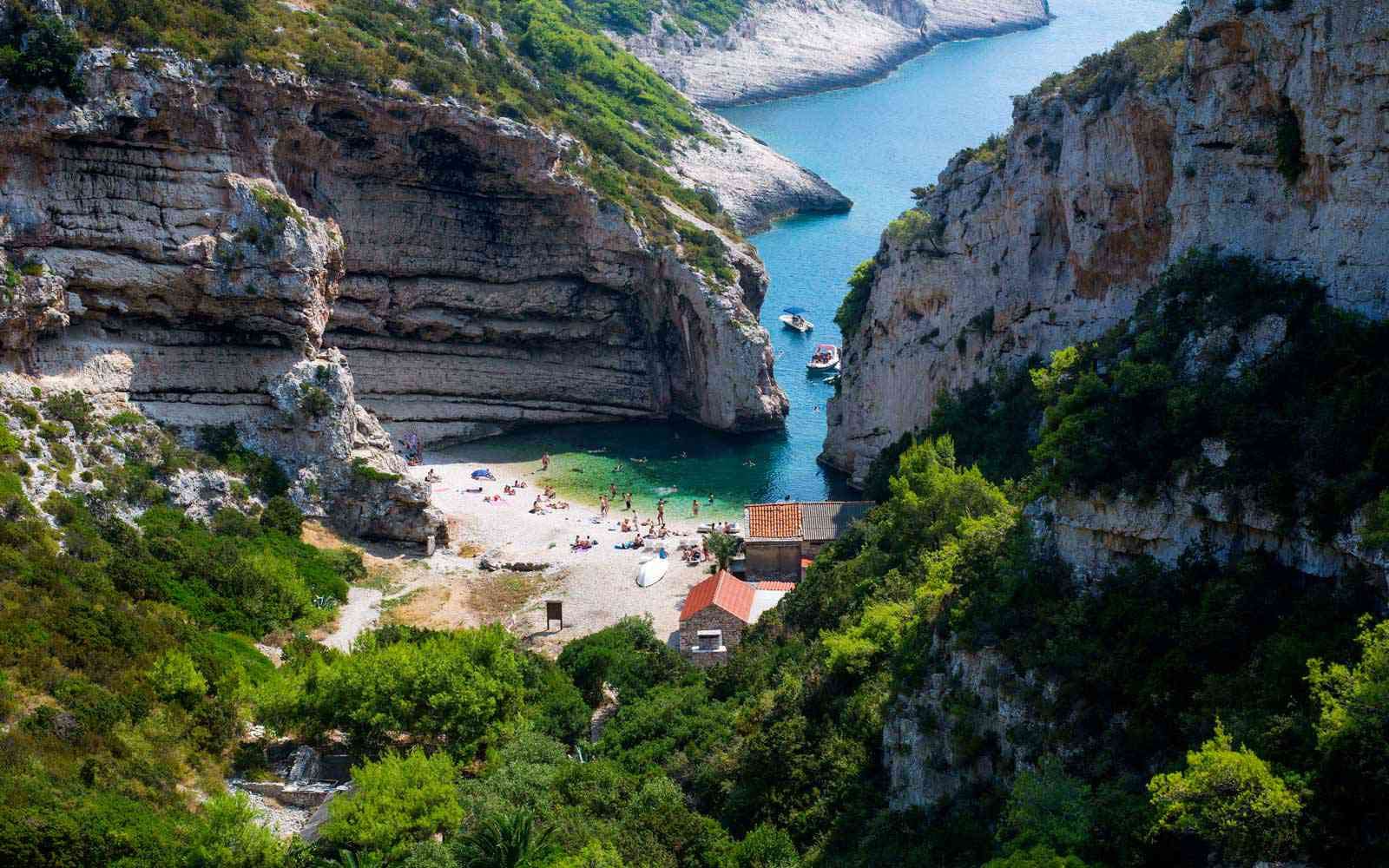
This is not indifference so much as confidence. Vis knows what it has: the Stiniva cove, a slash of beach between vertical cliffs accessible by a steep footpath; the Blue Cave on nearby Biševo, where morning light refracts through submerged openings to turn the water an unearthly luminous blue; the vineyards producing Vugava and Plavac Mali, indigenous varieties that taste of salt air and karst soil; the military tunnels bored into hillsides, now open for tours that trace the island's Cold War decades.
The film, in this context, becomes one layer among many - a recent chapter in a much longer narrative. Visitors who arrive because of cinematic association often find themselves drawn into older stories: the Greek colonists who founded Issa here in the fourth century BCE, the Roman ruins scattered across headlands, the medieval churches tucked into the island's interior, the fishing traditions that still dictate the rhythm of harbor life in Komiža.
The Alchemy of Light and Stone
What makes a place cinematic is rarely the same as what makes it livable, yet Vis manages both. The same qualities that drew location scouts - the clarity of light, the unspoiled coastline, the architecture that feels timeless rather than merely old - are precisely what make the island compelling for those of us who measure destinations not by attractions ticked off but by the quality of hours spent walking unpaved paths or watching fishing boats return at dusk.
Croatian stone, particularly the white limestone that forms the Dalmatian coast, has a specific relationship with sunlight. It absorbs and reflects simultaneously, so that even at midday, when Mediterranean heat can flatten other landscapes into washed-out stillness, Vis retains a kind of dimensionality. Shadows stay crisp. Colors - the dark green of Aleppo pines, the rust of terra-cotta roof tiles, the silver-grey of olive leaves - remain saturated. This is the alchemy that cameras love and that human eyes register as a subtle intensification of the real.
The island's coves and beaches, many reachable only by boat or on foot, offer a counterpoint to the more accessible stretches of Croatian coast. There is an element of effort required, a small barrier to entry that filters out the casual day-tripper and rewards those willing to scramble down rocky paths or hire a local skipper. This is not exclusivity in the economic sense - most of Vis remains refreshingly affordable - but rather a kind of self-selection that has helped preserve the island's character even as visitor numbers have grown in the years since the film's release.
Beyond the Frame
We have learned to be wary of destinations that define themselves primarily through their screen appearances. The risk is always that the place becomes a backdrop for other people's fantasies rather than a location with its own texture and complexity. Vis sidesteps this by virtue of having been too many things, for too long, to be reduced to a single cinematic moment.
The island's recent history as a military zone created an accidental conservation effect, but it also shaped the population - the people who stayed, who maintained vineyards and fishing boats through decades of isolation, who rebuilt the tourism infrastructure from scratch in the 1990s. These are not communities performing tradition for visitors but rather continuing practices that have economic and cultural logic independent of any audience. The peka - meat and vegetables slow-cooked under a domed iron lid buried in coals - is not a tourist menu item but the way people here have always cooked for gatherings. The wine cooperatives pressing Vugava grapes into crisp whites are not boutique operations for the luxury market but the continuation of viticulture that predates the Roman Empire.
This layering of function and history gives Vis a density that purely resort-oriented islands often lack. There is infrastructure for visitors, certainly, but it exists alongside and interwoven with the infrastructure of daily life - the bakery that opens before dawn for locals and happens to make excellent pastries for hotel guests, the harbor where fishing boats and charter yachts share the same moorings, the trails that serve both hikers seeking views and farmers tending terraced plots.
The Quiet After the Cameras Leave
What happens to a place after the film crews pack up and the premiere fades from memory? For some destinations, there is a boom and then a gradual return to baseline. For others, the exposure catalyzes changes already underway, accelerating development that might have unfolded more slowly. Vis seems to have experienced something in between - a notable increase in awareness and visitor numbers, particularly in summer months, but not the wholesale transformation that can strip a place of its essential character.
The island's infrastructure limitations - a single ferry route, limited accommodation, the absence of an airport - act as natural throttles on growth. You cannot visit Vis on a whim or as part of a multi-island blitz. The journey requires planning, and once there, the scale of the place encourages a slower pace. This is an island for spending several days, for establishing a rhythm of morning swims and afternoon siestas and evening walks through Vis town's narrow streets.
At Global Chic Voyage, we measure a destination's resilience not by its resistance to change but by its ability to absorb visitors without losing the qualities that made it compelling in the first place. Vis, for now, seems to be managing that balance - welcoming the curious and the film-inspired while maintaining the routines and landscapes that give the island its particular identity. Whether that balance holds as awareness continues to grow remains an open question, but the island's history of weathering larger disruptions - military occupation, post-war transition, the collapse of Yugoslavia - suggests a capacity for adaptation without erasure.
The understudy, it turns out, was never really standing in for anyone. Vis was always itself, playing its own long game, and the cameras simply happened to be watching for a moment.
Photo: Matthew Baker / Getty Images
Spot something wrong? Email editors@globalchicvoyage.com. We log every correction publicly.
RELATED
SEE ALL →
8 Aug 2026 / 5 min

7 Aug 2026 / 5 min

31 Jul 2026 / 5 min

31 Jul 2026 / 5 min