
Where the Gods Once Walked: Finding Solitude on Calabria's Forgotten Shore
Beyond the crowds of the Amalfi Coast lies Tropea, a cliffside town where ancient myth meets crystalline waters and the pace of summer slows to a Mediterranean whisper.
SI
3 Jul 2026 · 5 MIN READ · UPDATED 17 AUG 2026
The Last Unspoiled Corner
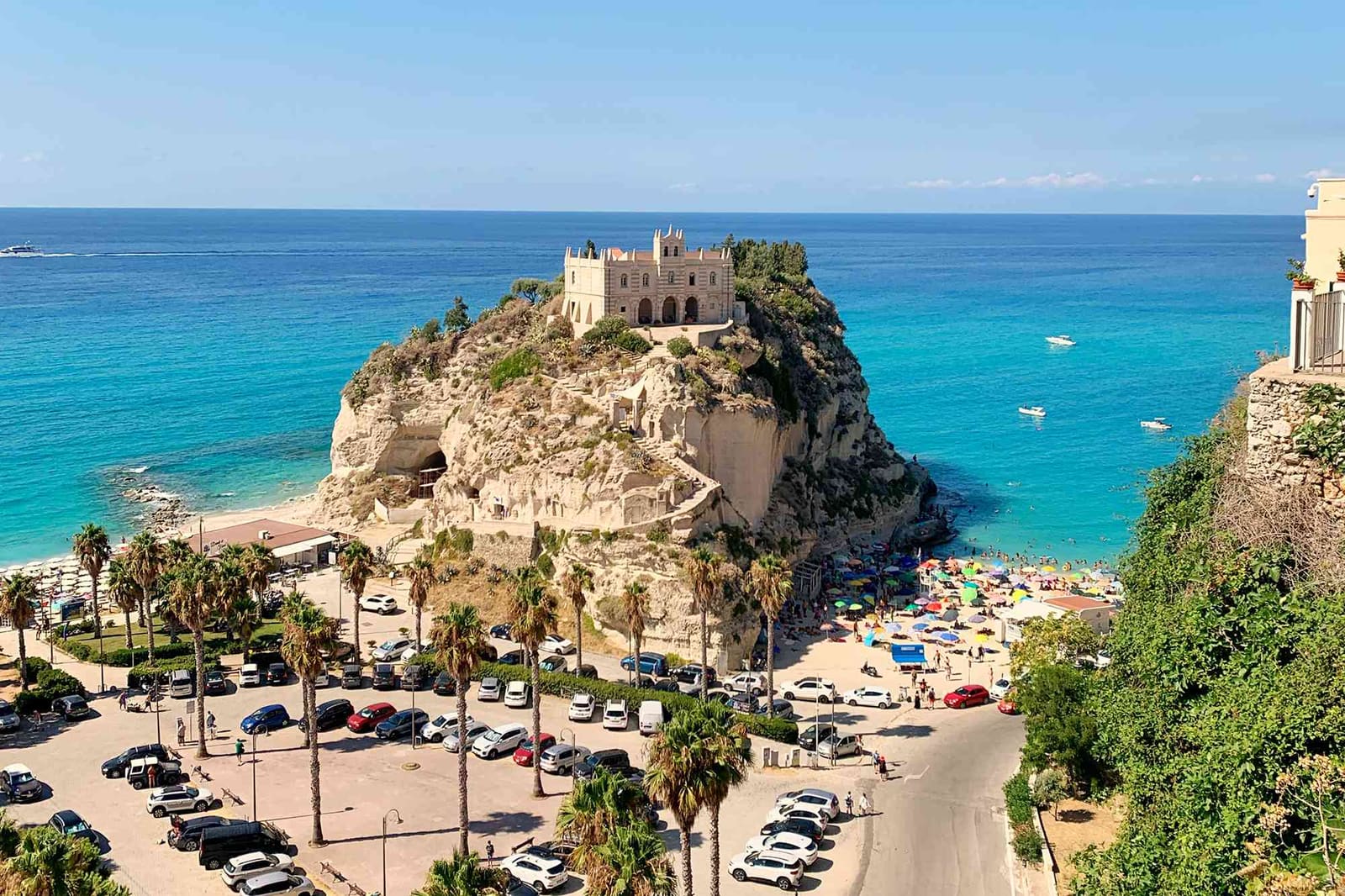
There is a particular quality of light that belongs only to Italy's southern toe, where the Tyrrhenian Sea meets cliffs of pale sandstone and the air carries both salt and the scent of bergamot groves. In Tropea, a medieval town perched above a coastline the ancients called the Coast of the Gods, that light falls on beaches largely untouched by the throngs that have claimed Positano and Capri. At Global Chic Voyage, we've watched travelers discover this corner of Calabria with the same quiet wonder one reserves for secrets worth keeping.
The town itself clings to a promontory fifty meters above the water, its Norman cathedral and palazzo facades forming a skyline that has changed little in centuries. Below, beaches of powdery white sand stretch in crescents between rock formations, the water graduating from pale turquoise to deep sapphire as the seabed drops away. What distinguishes Tropea is not simply its beauty, which is considerable, but its refusal to commodify that beauty into the kind of frenzied tourism that has transformed so much of the Mediterranean.
A Geography of Myth and Margin
Calabria occupies a peculiar position in the Italian imagination: too remote to be fashionable, too rugged to be easily domesticated by resort developers, yet possessing a coastline that rivals anything further north. The Coast of the Gods, stretching roughly from Pizzo to Nicotera, earned its name from Greek settlers who saw in its dramatic topography the dwelling place of divine beings. Hercules, according to legend, rested here during his labors. Tropea itself is said to have been founded by the hero, one of several ports he established along this shore.
The geography that inspired myth has also protected the region from over-development. The Aspromonte mountains rise steeply from the coast, their forests and gorges creating a natural barrier that has kept mass tourism at bay. Infrastructure remains modest. The nearest major airport lies in Lamezia Terme, an hour's drive north, and the winding coastal roads discourage the kind of day-trip crowds that descend on more accessible destinations. This marginality, once an economic liability, has become Tropea's greatest asset in an era when travelers increasingly seek places that have not yet been curated into uniformity.
The Beaches That Time Overlooked
To speak of Tropea's beaches is to catalog a series of small revelations. Spiaggia del Cannone, directly below the old town, can be reached by a long staircase cut into the cliff face. The descent itself becomes part of the ritual, each switchback offering a slightly altered perspective on the Sanctuary of Santa Maria dell'Isola, the whitewashed church that crowns a rocky outcrop jutting into the sea. By the time you reach the sand, the town above feels like another world.
The water here is startlingly clear, the kind of transparency that allows you to watch small fish navigate the rocks at depths of three or four meters. Unlike the pebble beaches common elsewhere on the Tyrrhenian coast, Tropea's sand is fine and pale, its texture more reminiscent of the Caribbean than the Mediterranean. The absence of commercial development means no rows of regimented umbrellas, no beach clubs blasting music across the shore. Visitors bring their own shade and settle where they please, the beach arranging itself organically rather than according to a rental grid.
Beyond the town beaches, the coastline reveals itself in a series of coves and promontories accessible by boat or by footpaths known primarily to locals. Capo Vaticano, a short drive south, offers granite cliffs and hidden grottos where the water takes on an almost unreal intensity of color. Praia i Focu, named for the way sunset light seems to set the cliffs ablaze, remains largely unmarked on tourist maps. These are not beaches designed for social media documentation, but for the kind of slow, embodied presence that has become rare along Europe's more celebrated shores.
The Architecture of Restraint
Tropea's old town is a study in understated elegance. Narrow lanes paved with basalt cobblestones wind between buildings of honey-colored tufa, their balconies wrought iron rather than the more ornate Baroque flourishes of Sicily or Naples. The Norman cathedral, dating to the twelfth century, anchors the main piazza with a severity softened only by its rose window and the warm patina of its stone. Inside, a Byzantine icon of the Madonna is said to have been painted by Saint Luke himself, though scholars date it more conservatively to the medieval period.
What strikes the careful observer is the absence of architectural pretension. Unlike coastal towns that have rebuilt themselves to accommodate tourism, Tropea has largely resisted the temptation to prettify or theme-park its historic core. Buildings show their age honestly, plaster crumbling in places, shutters faded by decades of sun and salt air. The effect is not one of neglect but of authenticity, a visual vocabulary that speaks to continuous habitation rather than preservation for tourists.
The town's restaurants reflect a similar restraint. Menus lean heavily on Calabrian staples: 'nduja, the region's fiery spreadable salami; swordfish and tuna caught in the Strait of Messina; red onions grown in the surrounding hills, sweet enough to eat raw. Tropea's red onion, a variety with IGP protected status, appears in nearly every dish, from pasta sauces to frittatas to marmalades served with aged pecorino. This is cooking rooted in place, in the agricultural rhythms and fishing traditions that have sustained the region for centuries, rather than in the cosmopolitan fusion that characterizes so many resort destinations.
The Question of Scale
What Tropea offers, ultimately, is a lesson in scale. The town's population hovers around six thousand, swelling modestly in summer but never approaching the crush of more famous destinations. This human scale extends to the infrastructure: hotels are small, often family-run conversions of historic buildings; shops sell locally made ceramics and preserves rather than luxury brands; the evening passeggiata along Corso Vittorio Emanuele remains a genuinely social ritual rather than a tourist spectacle.
There is a growing recognition among luxury travelers that true exclusivity lies not in five-star amenities but in access to places that have retained their character and their connection to local life. Tropea represents a particular kind of luxury: the luxury of space, of unhurried time, of immersion in a landscape and culture that have not been fundamentally altered to accommodate visitors. It is the luxury, increasingly rare in Europe, of feeling that you have arrived somewhere real.
The challenge, of course, is how to share such a place without destroying what makes it valuable. Tropea has so far managed a delicate balance, attracting discerning travelers while avoiding the kind of development that would transform it into another Portofino or Taormina. The question is whether that balance can hold as more people discover what has remained, until now, one of Italy's best-kept secrets.
When the Light Changes
We return to that particular quality of light, the way it falls across Tropea in the late afternoon when the day's heat begins to ease. From the belvedere near the cathedral, you can watch the sun descend toward the Aeolian Islands, visible on clear days as dark silhouettes on the horizon. The sea takes on a metallic sheen, the cliffs deepen to amber, and for a moment the name Coast of the Gods seems less like marketing than simple description.
This is the Tropea worth seeking: not as a checklist destination or an Instagram backdrop, but as a place that rewards attention and slowness. A place where the beaches remain uncrowded not because they are inferior but because they require a certain deliberateness to reach. Where the pleasures are quiet ones, elemental and enduring. In an age of overtourism and homogenized luxury, such places have become the true rarities, worth protecting and worth the journey to find.
Photo: Laura Itzkowitz / Travel + Leisure
Spot something wrong? Email editors@globalchicvoyage.com. We log every correction publicly.
RELATED
SEE ALL →
8 Aug 2026 / 5 min
7 Aug 2026 / 5 min
31 Jul 2026 / 5 min
31 Jul 2026 / 5 min