
Where the Serengeti Keeps Its Secrets
Inside a Tanzanian wilderness where the eastern black rhino still walks and the acacia plains stretch into memory.
SI
8 Jul 2026 · 5 MIN READ · UPDATED 17 AUG 2026
The First Sighting
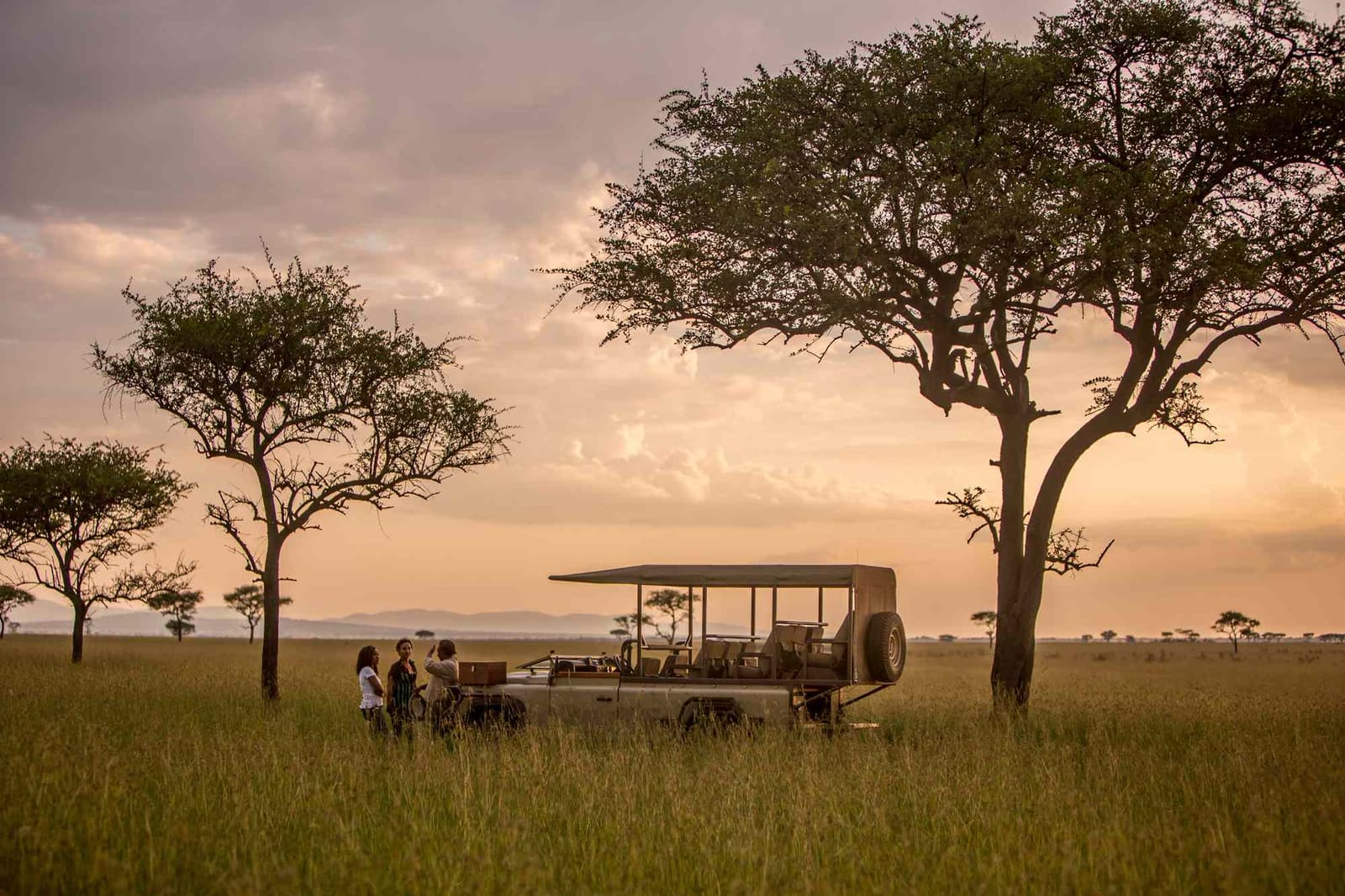
Dawn arrives slowly in the Serengeti, not as a sudden event but as a gradual unfolding of color across the acacia canopy. We sat in the open Land Cruiser, thirty minutes from the lodge, when our guide lifted his hand and cut the engine. Silence settled over the grassland like dust. Then, through the morning haze, a cheetah emerged, her coat catching the early light, three cubs trailing behind her in single file.
At Global Chic Voyage, we've spent years tracking the evolution of safari travel, watching as the industry shifts from trophy-hunting nostalgia to something quieter and more accountable. This particular corner of the Serengeti, the Grumeti concessions stretching west toward Lake Victoria, represents that shift in its most refined form. Here, wildlife reserves operate not as theme parks but as working laboratories, where conservation funding flows directly from lodge revenues and where animal corridors remain unbroken by fencing or development.
The cheetah paused, turned her head toward us with amber indifference, and continued her morning patrol. Her cubs, perhaps four months old, tumbled over each other in the tall grass, practicing the stalk-and-pounce choreography that would one day mean survival. We watched for twenty minutes, cameras silent, before she led them into a thicket of whistling thorn and disappeared.
A Landscape Built on Migration
The Grumeti reserves occupy a critical position along the western corridor of the greater Serengeti ecosystem, a 350,000-acre expanse of riverine forest, open plains, and rocky kopjes that serves as both permanent habitat and seasonal thoroughfare. During the annual wildebeest migration, typically between May and July, more than a million animals funnel through these concessions on their way north toward the Maasai Mara, transforming the landscape into a living, breathing spectacle of movement.
But the reserves reveal their true character outside migration season, when the resident species reclaim the land and the visitor-to-animal ratio tilts decidedly in favor of the latter. Giraffe move through the fever trees in loose, unhurried groups, their necks swaying like metronomes. Hippo congregate in the Grumeti River's deeper pools, their eyes and nostrils breaking the surface in neat rows, exhaling mist into the afternoon heat. Elephant herds, matriarchs leading, cross the plains with a kind of deliberate grace that makes the word "herd" feel inadequate.
We encountered them all over the course of five days, each sighting building on the last, each animal encountered on its own terms rather than ours. There is no hurry here, no checklist mentality. The reserve's low lodge density ensures that game drives unfold in near solitude, with hours passing between vehicle sightings. It is luxury travel stripped of its usual performative excess, reduced to its essence: time, space, and proximity to wildness.
The Rarest Encounter
On the fourth morning, we found the eastern black rhino.
This subspecies, critically endangered with fewer than a thousand individuals remaining across East Africa, occupies a precarious position in the continent's conservation narrative. Poaching pressures have decimated populations over the past half-century, and even well-protected reserves struggle to maintain viable breeding groups. The Grumeti reserves, in partnership with the Tanzanian government and international wildlife organizations, have established a dedicated rhino monitoring program, complete with armed anti-poaching patrols and satellite tracking.
The animal we encountered, a mature female, stood in the shade of a balanites tree, her prehistoric silhouette unmistakable even at a distance. Her horn, shorter than her southern counterparts, curved gently upward, a vestige of evolutionary adaptation that now makes her a target. We watched from the vehicle, engine off, as she scraped at the dry earth with her front foot, scent-marking her territory. She knew we were there but showed no concern, continuing her routine with the kind of focus that suggested we were irrelevant to her daily calculus.
Our guide, a Tanzanian ecologist who has worked in the Serengeti for fifteen years, explained that this particular female has successfully raised four calves in the reserve, each one contributing to the slow, painstaking recovery of the subspecies. Her presence here, he said, is both a conservation victory and a reminder of how fragile that victory remains. One poaching incident, one fence erected in the wrong corridor, and the entire effort collapses.
The Architecture of Observation
The lodges themselves, positioned along the Grumeti River and within view of the western plains, operate according to a design philosophy that prioritizes transparency over enclosure. Canvas and reclaimed timber replace concrete; open-air pavilions replace air-conditioned lounges. Guest suites face outward, floor-to-ceiling glass dissolving the boundary between interior and exterior, so that morning coffee becomes a front-row seat to elephant crossings and afternoon siestas are scored by the distant percussion of hippo grunts.
This is not accidental. The architecture here reflects a broader shift in luxury safari design, one that rejects the colonial-era model of fortress-like camps insulated from the surrounding environment. Instead, these lodges embrace permeability, allowing the landscape to dictate the guest experience rather than the other way around. Meals are served outdoors, under the acacia canopy or beside the river, with no walls to separate diners from the soundscape of the bush. Sleep comes with the chorus of nocturnal species, hyena and nightjar and the occasional lion's roar reverberating through the valley.
It is an aesthetic that requires a certain comfort with proximity, a willingness to accept that you are a guest in someone else's home. For travelers accustomed to the insulated predictability of resort compounds, it can feel disorienting. For those seeking genuine immersion, it is precisely the point.
The Ethics of Presence
Safari travel carries an uncomfortable paradox: the very act of witnessing wildlife generates the revenue required to protect it, yet that same presence, if mismanaged, can disrupt the behaviors and habitats it seeks to preserve. The Grumeti reserves navigate this tension through strict visitation caps, rigorous guide training, and a financial model that channels lodge profits directly into anti-poaching operations, habitat restoration, and community development programs in the surrounding villages.
We saw evidence of this throughout our stay. Game drives adhere to strict protocols: no off-road driving except in designated areas, no approaching animals within a certain distance, no more than two vehicles per sighting. Guides carry binoculars and spotting scopes to allow observation without intrusion. The lodges employ local Maasai staff, many of whom grew up in the region and bring generational knowledge of the land and its rhythms.
This is conservation as economic engine, a model that asks travelers to see themselves not as consumers of an experience but as participants in a larger project. It is a subtle reframing, but one that shifts the emotional register of the trip from entitlement to stewardship. You leave not with a sense of having conquered the Serengeti, but with a deeper understanding of how little of it you truly touched.
The Long View
On our final evening, we sat on the lodge deck as the sun dropped below the horizon, painting the sky in layers of amber and violet. A lone giraffe stood silhouetted against the fading light, motionless, as if posing for a photograph that no one would take. The Grumeti River, reduced to a trickle in the dry season, wound through the valley below, its banks lined with fever trees and the occasional cluster of impala.
Our guide joined us, pointing out the constellations beginning to emerge overhead, the same stars that have oriented human and animal migration for millennia. He spoke about the challenges ahead: climate change altering rainfall patterns, human population growth encroaching on wildlife corridors, the persistent threat of poaching despite improved enforcement. But he also spoke about resilience, about the eastern black rhino calves born in the reserve over the past decade, about the return of wild dog populations, about the community schools and clinics funded by lodge revenues.
The Serengeti, he said, is not a museum. It is a living system, constantly adapting, constantly negotiating the terms of its survival. Our role, as visitors, is not to preserve it in amber but to support the conditions that allow it to continue evolving on its own terms.
We sat in silence for a long time after he left, watching the stars multiply overhead, listening to the nightjars call from the acacia thicket. Somewhere in the darkness, the cheetah and her cubs were settling into their den. The black rhino was scraping at the earth, marking her territory. The hippos were emerging from the river to graze under cover of night. And the Serengeti, indifferent to our presence, continued its ancient rhythms, as it has for millennia, as it will, if we are careful, for millennia more.
Credit: Singita Grumeti
Spot something wrong? Email editors@globalchicvoyage.com. We log every correction publicly.
RELATED
SEE ALL →
8 Aug 2026 / 5 min
7 Aug 2026 / 5 min

31 Jul 2026 / 5 min
31 Jul 2026 / 5 min